CHAPTER 16
How to Stick with Good Habits Every Day
Read It
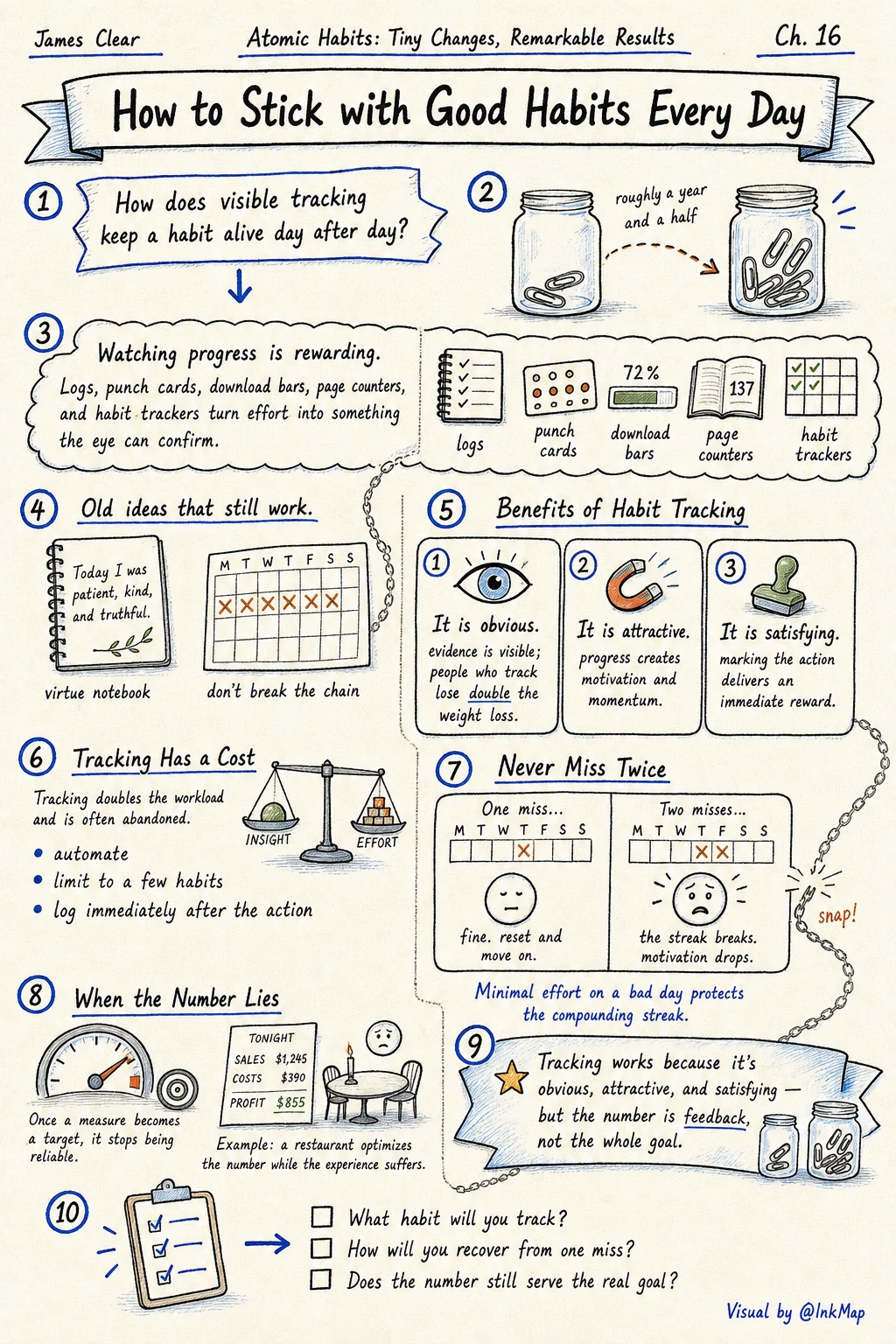
Tracking turns “I think I’m doing okay” into a row of marks you can see. It works because it bundles three of the four laws into one act: the record itself is the cue, the growing chain is the reward, and the satisfaction of crossing off another day is immediate. But that same visibility has a shadow. The moment the streak becomes the point, you start doing hollow versions of the habit just to keep the number alive. A journal entry that says nothing, a workout that barely moves you. The measure was supposed to reflect the behavior, not replace it.
 Open full image ↗
Draw It
Prose makes it easy to blur the line between the habit and its record. I wanted to separate the feedback loop—action, visible progress, renewed motivation—from the failure loop that starts when you miss a day. The first loop is self-reinforcing; the second needs an explicit rule: never miss twice. The diagram also splits the real goal from the proxy number, because that’s where tracking quietly corrupts. Once you see them as two different layers, it’s obvious why a perfect streak can coexist with a habit that has stopped meaning anything.
Rethink It
Teams can celebrate velocity while the product gets worse. The number is easy to see; the value is not. The same trap shows up in writing streaks, reading challenges, step counts. The fix isn’t to abandon tracking—it’s to pick one or two cheap metrics and then regularly ask whether they still point toward the person you’re trying to become. If the answer is no, the metric has become the goal, and it’s time to change what you measure.
Take It With You
Consistency isn’t a perfect chain. It’s the refusal to let a single miss become the start of a new pattern. The rebound matters more than the streak.