CHAPTER 10
How to Find and Fix the Causes of Your Bad Habits
Read It
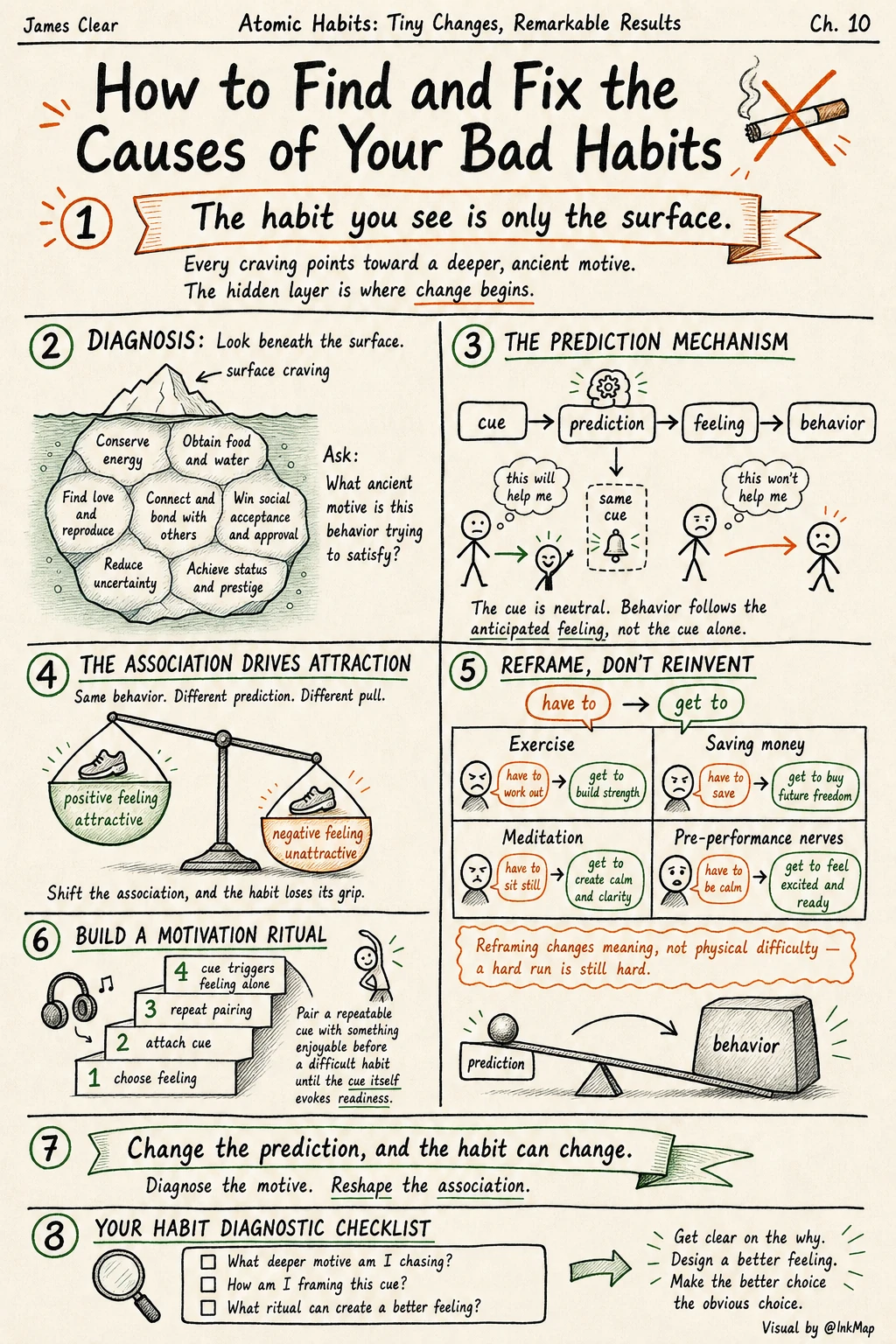
A craving feels like the problem, but it is really a prediction wearing an emotion. The brain sees a cue, guesses what it means, and that guess—not the cue itself—drives the next move. Two people can meet the same trigger and walk in opposite directions because their predictions differ. The practical question is not how to silence desire, but how to change what a habit predicts.
Beneath every modern craving sits one of a few ancient motives: reduce uncertainty, win approval, conserve energy. Products and routines borrow these old engines and point them at new targets. Reframing works because it rewires the prediction. "I get to train" and "I have to train" describe the same hour, but they forecast different feelings, and the feeling decides whether the habit survives.
 Open full image ↗
Draw It
The chain from cue to prediction to feeling to action is easy to flatten into "trigger and response." What deserves space is the middle: the prediction is the true lever. A visual can show that the cue is only raw input, while the brain's interpretation does the steering. That turns an abstract idea about motives into something you can intervene on.
Rethink It
A notification pings during deep work. If the brain predicts relief from uncertainty, you reach for the phone. If it predicts an interruption, you stay. The cue is identical. This is why blocking the cue alone often fails—the prediction remains. Reframing the meaning of the interruption, or rehearsing the feeling of staying, changes the forecast and therefore the action.
Take It With You
Do not fight cravings directly. Trace them to the prediction, then edit the prediction. A motivation ritual—pairing a neutral cue with a chosen feeling until the cue alone summons it—is a small, repeatable way to do that. It works because it treats emotion as the mechanism, not the obstacle.