CHAPTER 11
Walk Slowly, but Never Backward
Read It
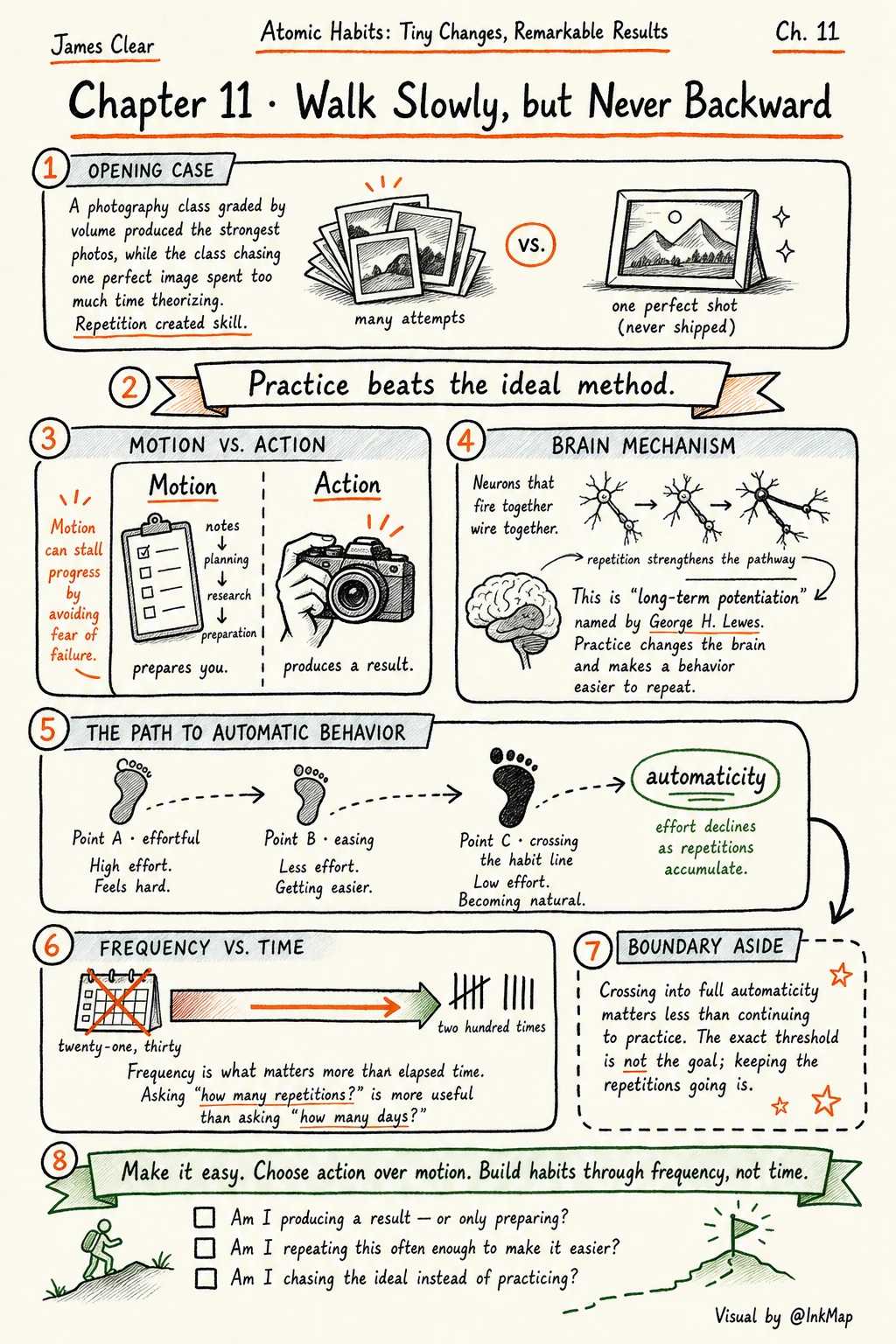
The photography class experiment is a verdict on how skill actually forms. Students told their grade depended on volume produced more and better work than those told to chase one perfect image. Quantity forced iteration; perfection invited hesitation. The lesson generalizes: planning feels like progress, but only doing changes the brain.
Motion and action look similar from the outside. Both involve effort, both can fill a morning. The difference is that motion rehearses a decision, while action produces a result. Motion is safe because it cannot fail; action is risky because it can. That is exactly why action is the only path to automaticity. The brain does not lower the cost of a path you have never walked.
 Open full image ↗
Draw It
The motion–action split is a fork, not a spectrum. One side loops back to more preparation; the other side crosses the habit line through repetition. Drawing them as divergent paths makes visible why "learn more" and "do more" do not accumulate the same way. It also explains why a beginner's ten imperfect attempts beat one delayed perfect start.
Rethink It
Writing stalls when research becomes a hiding place. Ten published pieces reveal recurring weaknesses that no amount of reading exposes. The first draft is not the final step of preparation; it is the beginning of feedback. Repetition is how you discover what to improve, not just a way to lock in what you already know.
Take It With You
Preparation reduces uncertainty. Only action produces new evidence. The number of days matters less than the number of reps. But the rule has a boundary: repetition only helps when the feedback loop is real. Repeating a flawed motion without correction just automates the flaw. Volume works when each iteration teaches.