CHAPTER 09
The Role of Family and Friends in Shaping Your Habits
Read It
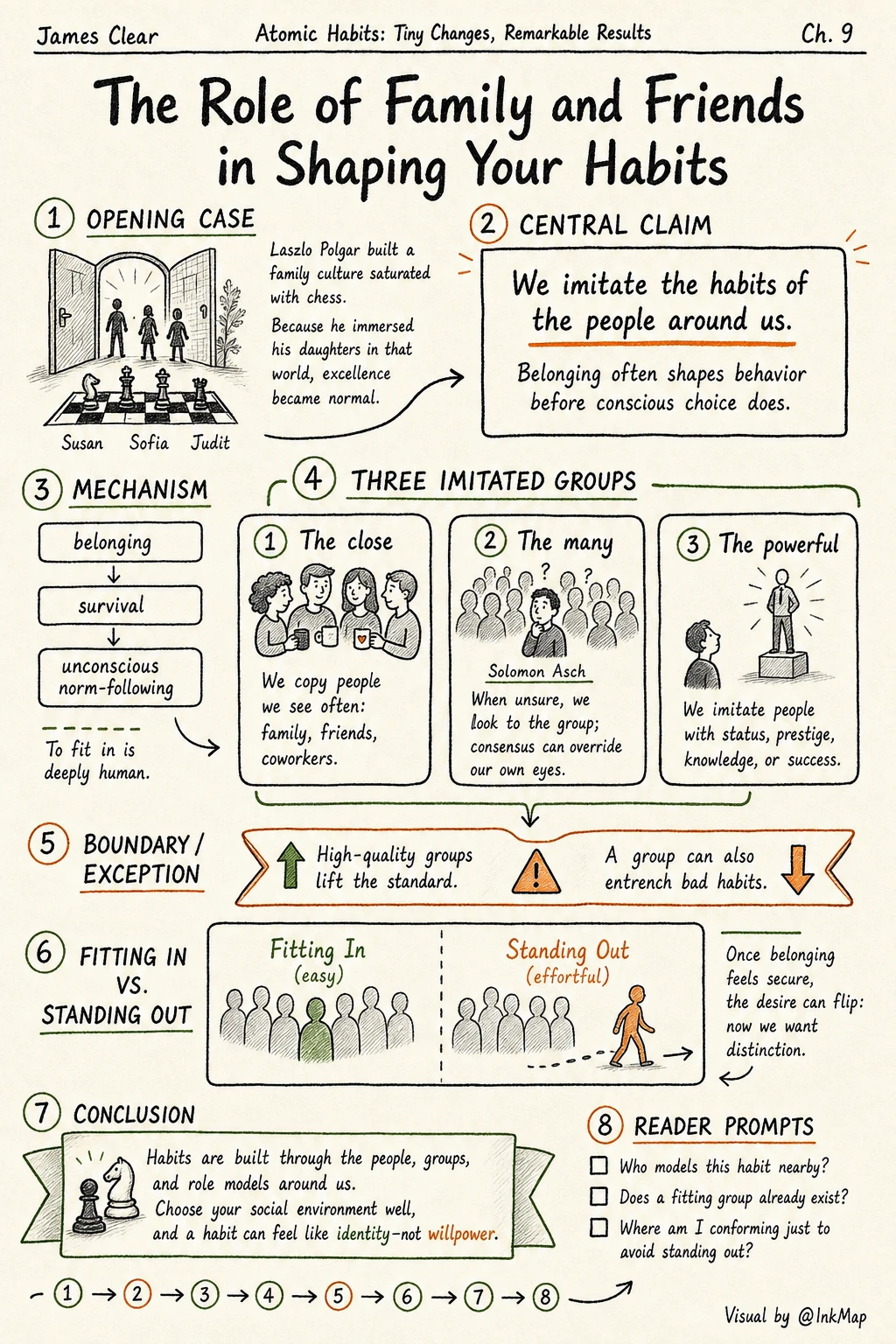
We like to think of habits as personal choices, but most of them are inherited from the people around us. Clear’s argument is evolutionary: humans survived by fitting into groups, so belonging feels like safety. That’s why we imitate three categories of people without realizing it—those close to us, the majority, and the powerful. The friend who runs every morning makes running feel normal. The crowd that checks phones during meetings makes checking phones feel acceptable. The admired leader who works late makes late nights feel aspirational. None of this requires conscious decision. The behavior just feels right because it aligns with the group. That’s the double edge: social imitation amplifies whatever the group already does. If the group’s habits are healthy, you rise with them. If not, you sink. The chapter’s conclusion is both simple and radical: choose your communities deliberately, because the group you join is the habit you’ll absorb.
 Open full image ↗
Draw It
The chapter names three social forces, but the deeper structure is a matching problem: each force answers a different psychological need. Proximity answers belonging, the majority answers certainty, and status answers aspiration. I wanted the visual to show these as three distinct pulls on the same behavior, because they often conflict. A behavior can feel right because your friends do it, even when the majority doesn’t, or because a high-status person does it, even when it’s objectively harmful. Mapping the forces separately makes it easier to see which one is actually driving a given habit.
Rethink It
I joined a writing group not because I needed accountability but because I needed writing to feel normal. When everyone around me treats daily writing as unremarkable, the habit stops requiring willpower. The same applies in engineering. A team that treats code review as a routine part of shipping produces better reviews than a team that treats it as an occasional chore—not because individuals are more virtuous, but because the norm is different. The boundary: the group has to share something real with you. If the only connection is the habit itself, the belonging is shallow and the influence won’t last.
Take It With You
When a change keeps failing, I stop asking what’s wrong with me. I ask who I’m spending time with. Sometimes the fastest way to change a habit is to change the room you’re standing in.