CHAPTER 08
How to Make a Habit Irresistible
Read It
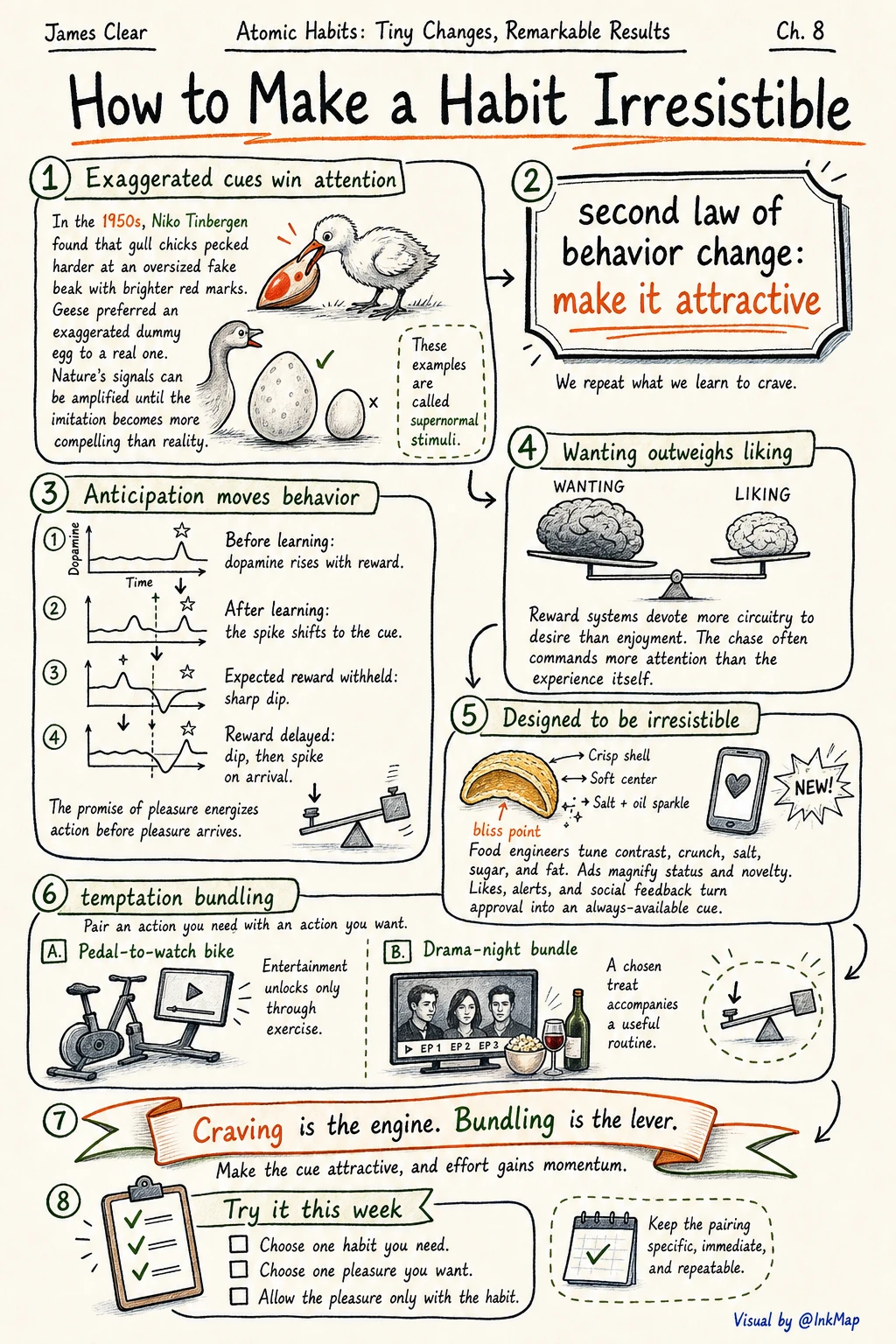
The second law of behavior change—make it attractive—rests on a surprising biological fact: dopamine spikes before the reward, not just after. We’re driven by anticipation, not satisfaction. That’s why the thought of checking your phone feels better than the actual scroll. Modern products exploit this ruthlessly. They’re supernormal stimuli—exaggerated cues that trigger stronger responses than anything natural. Bright packaging, infinite feeds, variable rewards: all engineered to keep the brain in a state of wanting. Clear’s insight is that this same machinery can be redirected. Temptation bundling pairs something you need to do with something you already crave, so the anticipation of the treat pulls you toward the task. “I can only listen to my favorite podcast while I run.” The craving for the podcast becomes the engine for the run. The chapter closes by asking readers to spot these engineered cues in their own lives—not to eliminate them, but to understand them well enough to use them.
 Open full image ↗
Draw It
The key distinction here is between “wanting” and “liking.” The brain has far more capacity for wanting than for liking, which is why anticipation feels stronger than the payoff. I wanted the visual to show craving as the driver that initiates action, with reward as a secondary event. The diagram separates the anticipation phase from the consumption phase, making it clear that temptation bundling works by attaching a strong craving to a weak one. That’s a specific mechanism, not just a motivational trick.
Rethink It
A writing habit can be paired with a playlist reserved for writing. The music isn’t the reward; anticipating it helps open the document. But the boundary matters. If the bundled treat is too strong, it can overshadow the task. A podcast that’s too gripping makes the run feel like an interruption. The pairing has to be calibrated so the craving pulls you toward the habit without hijacking it. If a habit only works with an increasingly intense treat, the underlying behavior probably isn’t worth keeping.
Take It With You
Attraction is a tool for starting, not a reason for staying. I want the anticipation to point me toward choices I’ll still respect in a year, not just toward the next dopamine hit.