CHAPTER 03
How to Build Better Habits in 4 Simple Steps
Read It
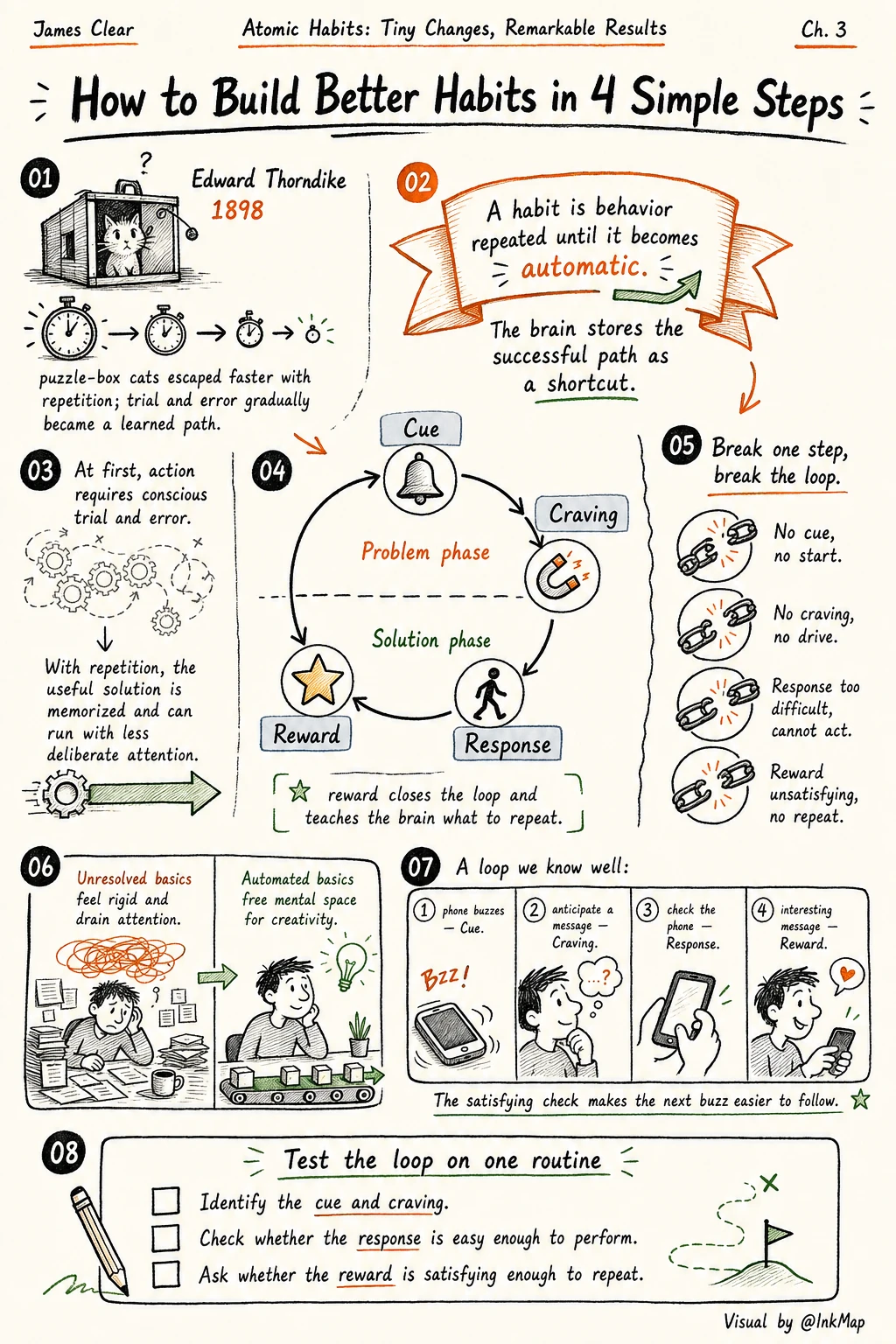
A habit is not what happens when willpower fails. It is what the brain does to save attention: it notices that a certain response to a cue reliably produces a reward, then automates the whole sequence. Cue, craving, response, reward—four steps that run in a near-instant loop, mostly below awareness. The cue is the trigger, the craving is the desire for a change in internal state, the response is the action, and the reward is what teaches the brain to repeat it. All four are required. Remove any one, and the habit cannot form or persist. That turns “Why can’t I stick with this?” from a personality judgment into a diagnostic question: which step is broken? Is the cue invisible, the craving weak, the response too hard, or the reward too delayed? The loop is not a checklist; it is a continuous cycle, and understanding it is the foundation for every technique that follows.
 Open full image ↗
Draw It
The four stages are not a linear list. They are a feedback loop: the first two define the problem, the last two attempt a solution. Visualizing the loop gives each of the four laws a precise point of intervention. It also lets you locate the failure: a missing cue, insufficient attraction, too much friction, or feedback that arrives too late. That is far more useful than a generic “be more disciplined.”
Rethink It
Suppose you want to build a reading habit but keep the book in a drawer, schedule reading for late at night, and never record what you finish. The failure is not a lack of self-control. Put the book on the table, attach reading to an existing routine, lower the bar to a few pages, and leave a short note after each session. Each change repairs a different part of the loop. The habit either forms or the diagnosis gets sharper.
Take It With You
When a behavior will not stick, check which part of the loop is broken before judging whether you are trying hard enough. The loop is the unit of analysis, not the person.