CHAPTER 04
The Man Who Didn't Look Right
Read It
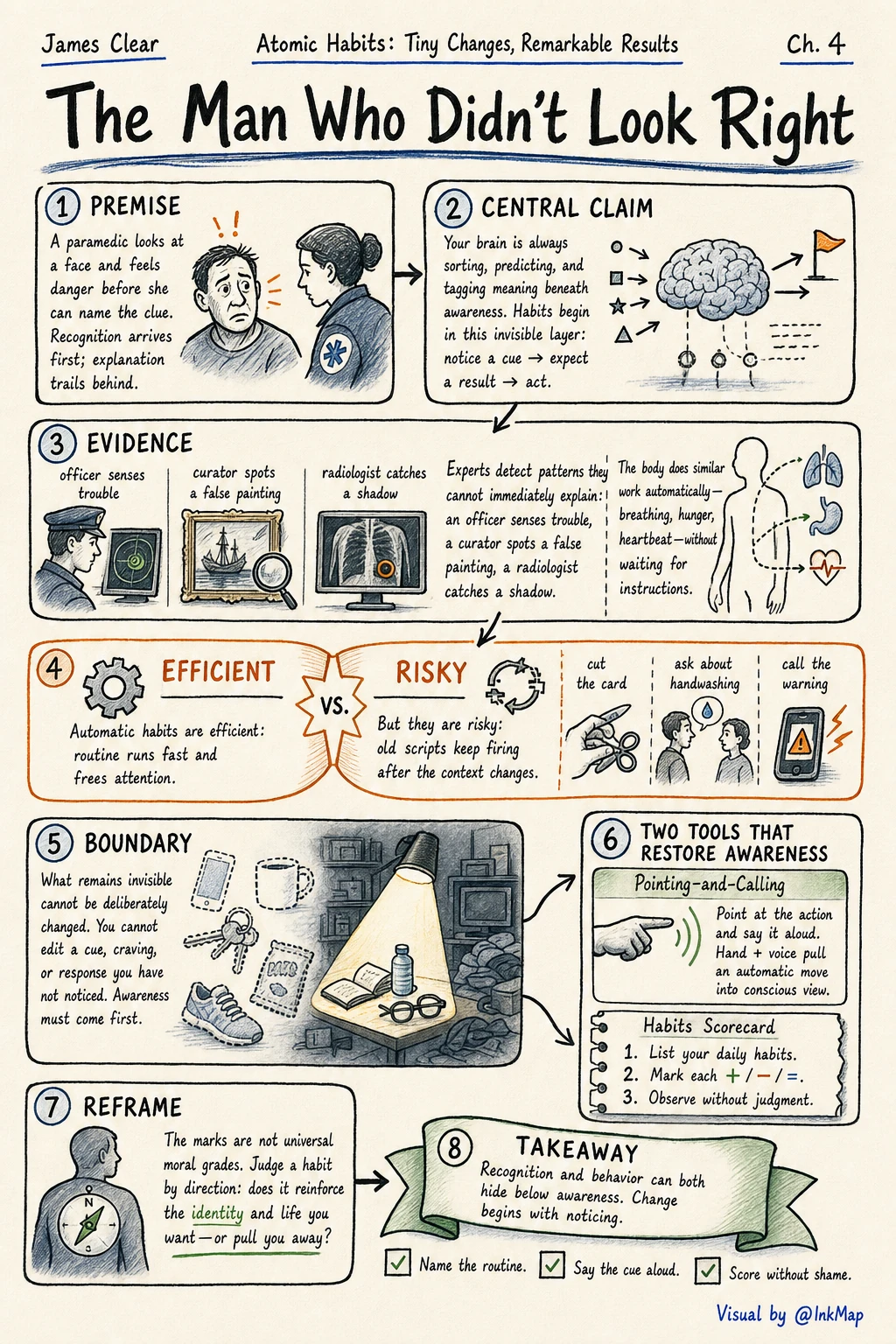
A paramedic walks into a family gathering, takes one look at her father-in-law, and knows something is wrong. She can’t say what. Hours later he’s in hospital. That story opens a door most of us don’t want to walk through: the machinery running our habits is the same machinery that runs expert intuition, and most of it is invisible to us. We don’t decide to notice the cues that set off our routines; we just act. That’s why changing a habit feels so slippery—you’re trying to edit a script you never consciously read. Clear’s move here is to make awareness the first intervention. Not willpower, not motivation. Just seeing. The Japanese train operators who point and call out every signal aren’t more disciplined than anyone else; they’ve made a deliberate ritual of dragging automatic action back into consciousness. The Habits Scorecard does the same thing for daily life: name the routine, mark it neutral, and suddenly it’s no longer invisible. Until you can see a habit as a choice you keep making, you can’t make a different one.
 Open full image ↗
Draw It
The trap in this chapter is treating “awareness” as a vague first step. I wanted to show it as a specific mechanism: the same nonconscious pattern-matching that lets a paramedic spot illness also lets a former lifeguard yell at strangers’ kids at a pool. The visual separates what’s automatic from what’s observable, and shows the two routes out—pointing-and-calling and the scorecard—as deliberate interruptions of the loop. Prose makes this sound like philosophy; a diagram makes it look like a switch you can flip.
Rethink It
An engineer can debug a system for hours before realizing they are following a routine from a previous project that no longer applies. The cue is “this looks similar,” and the habit fires before conscious judgment can object. Pointing-and-calling is a debugging tool for humans. In code review, saying out loud “I’m about to approve this because the author is senior” is uncomfortable, but it surfaces a cue that would otherwise stay hidden. The scorecard works the same way in team retrospectives: list the recurring behaviors first, judge them later.
Take It With You
Awareness is not a feeling; it’s a practice. The moment I stop naming my routines, they start running me. I’d rather be the train operator who points at the signal than the passenger who assumes the tracks are clear.