CHAPTER 02
How Your Habits Shape Your Identity (and Vice Versa)
Read It
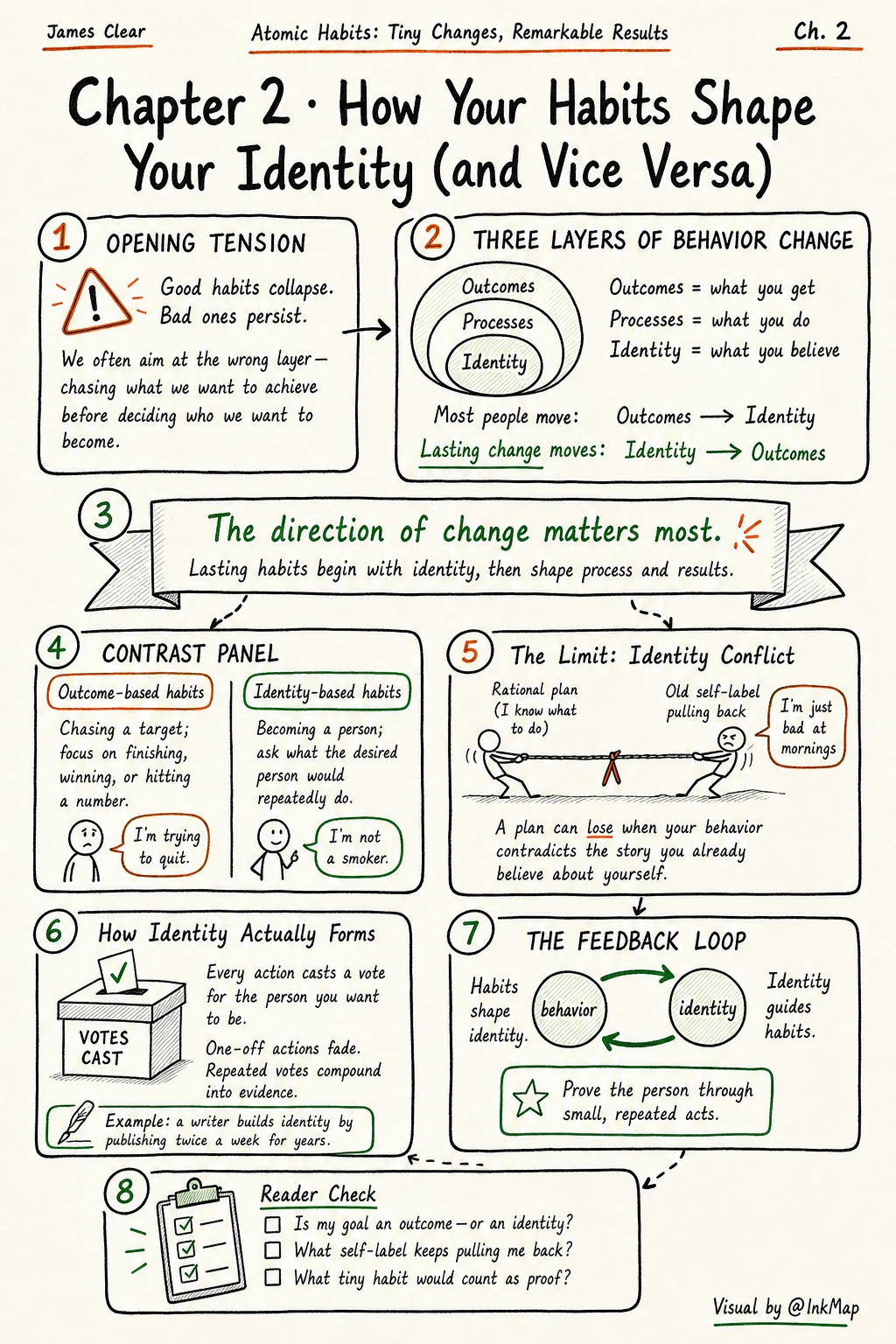
“I want to run a marathon” and “I am the kind of person who moves regularly” sound like two ways of saying the same thing. They are not. The first is a goal that ends at the finish line. The second is an identity that keeps shaping the next decision. Every action is a vote, and no single vote proves who you are, but the tally adds up. The reverse is also true: an old label can block change. If you believe “I’m just not a disciplined person,” every attempt feels like acting against your own nature. That is why identity has to be treated as revisable. You do not become a new person by declaration. You become it by accumulating small pieces of evidence—solving a problem, writing down an insight, explaining something to someone else—until the new self-image feels more natural than the old one. The loop runs both ways: actions build identity, and identity makes future actions easier.
 Open full image ↗
Draw It
Outcomes, processes, and identity form three layers, from the outside in. But identity and habits are not a one-way street; they form a feedback loop. Showing the layers and the loop together makes it clear why lasting change needs both concrete actions and a reinterpretation of what those actions are proving. It also shows why starting with identity is not a motivational trick but a structural advantage.
Rethink It
When learning a new skill, instead of only setting a goal like “finish ten courses,” let each real use of the skill become evidence: solve one work problem, write one explanation, teach one concept. Identity cannot be established by a single statement. It has to be persuaded, vote by vote, through repeated action. The question is not “Am I this kind of person yet?” but “What am I voting for with this next action?”
Take It With You
We do not first become a certain kind of person and then act accordingly. We act, repeatedly, and gradually come to believe we are that kind of person. The boundary is that identity work is slow and fragile; it cannot be rushed, and it collapses if the evidence stops accumulating.