STORY 01
The Resilient Life of a Triangle Warrior
 虎头锤 (Hutouchui) · Staff Engineer
Translated from the original Chinese essay · Read the Chinese original →
This is the first article in Wandering Under Different Stars.
Cong has always been a legend in my circle of friends.
I work in IT myself, so Cong's main job in DevOps isn't particularly special to me, but what he can do goes far beyond that.
He was the first person I knew who set his sights on running a full marathon from the very beginning. In six months, he spent three months studying scientific training on his own, lost over ten kilograms, and ran his first full marathon in under four hours.
He is also one of the most hands-on people I've ever met (not the most, because the carpenter in my family is truly exceptional). Living in Australia, you inevitably pick up some repair skills. But Cong doesn't just fix things—he has gradually renovated his home with his own hands and can answer all sorts of DIY questions from friends.
Using Cong's story to open this series is both a coincidence and an inevitability.
Because everyone is ordinary, and everyone is extraordinary.
On an October morning, the wind in Melbourne carried a chill.
For his first full marathon, Cong ran with a friend's race bib. After the thirty-five-kilometer mark, people on the course gradually slowed down—some walked, some crouched on the ground—but he kept running.
That day, he finished in under four hours on his first attempt.
The course was full of people gritting their teeth and pushing through, but he was like a machine precisely controlling his heartbeat.
He once said, "Willpower runs out; science doesn't."
Cong gave himself a name: "Triangle Warrior."
It wasn't about becoming an all-powerful hexagon warrior, but about choosing the stability of a triangular structure—not seeking to excel in every aspect, but to have a solid foundation.

Cong is from Tianjin.
Tianjin people have a habit of being born and raised there, even marrying someone from Tianjin. He likes reading history. The more history books he read, the clearer he became about what his life would look like if he stayed in Tianjin. And that life was not what he wanted.
He even went to have his fortune told. The reading contained the character "驿" (yì), as in a post station. He took it as a hint: he was destined to travel far. Canada, with its six-month winters, was immediately crossed off the list, and Australia opened its arms to welcome Cong.
Breaking Through at the Starting Line
It began in Wollongong.
He deliberately avoided Sydney and Melbourne and chose this small coastal city. Big cities were too bustling; he feared distraction and wanted to focus on his studies in a quiet place.
His grades were not bad, but opportunities were almost nonexistent.
This is probably the deadlock that every immigrant who comes to Australia for study encounters. Without local experience, you can't find a job; without a job, you can't gain experience.
This deadlock can only be broken by finding your own way out.
Once, he encountered a so-called "startup." They said they wanted a website built, promising to pay later, but asked him to start writing code first. Of course, there was no income in the end. But he still did it. He wrote the code and even deployed the application to the cloud. That was his first complete deployment experience.
He knew the other party was taking advantage of him, but he gritted his teeth and accepted. Not for them, but for himself—even if reality was unfair, he had to push himself to learn one step further.
Beyond that, he also worked on his own projects and put the code on GitHub. Line by line of commits was his way of breaking the deadlock. Since no one would give him a chance, he would create one for himself first.
IELTS also gave him a hard time. He took the test five times before passing. Every failure felt like a stone pressing on his heart. Relatives were waiting for him to return home, waiting to see him fail. He held back one thought: a person must fight for their own pride.
Meeting
After graduation, he moved to Melbourne. Actually, it was because a relative lived there.
That relative was an investment immigrant who had invested in beef import and export. He said to Cong: "I'll give you thirty thousand Australian dollars a year to come help me." The minimum salary for Australian graduates was fifty thousand, and Cong felt this was disrespectful. The relative dismissed it, saying, "Jobs are hard to find now. If you're so capable, go find a fifty-thousand-dollar job yourself."
Cong actually found one.
In 2014, he got a contract job paying three hundred Australian dollars a day. That was his first real income in Australia, and the best response to his relative.
It was also during that job-hunting period that he joined a hiking group and met his future wife. At that time, he had no permanent residency and no formal job, yet she firmly chose him.
"She has excellent judgment," Cong later said with a smile. His "choleric" wife was more action-oriented than his "phlegmatic" self, perfectly complementing Cong's resilience.
In the hardest times, having someone willing to stand by his side gave him confidence. Many years later, he still felt that moment was more important than any job offer.
Contract work in Australia can be truly unstable at times. Without warning, Cong's contract was not renewed. And just then, their first child was born. The family was left with only his wife's stable income.
"During that period, I was living off her," he said. With no income, he felt awkward and even sensitive. The house was quiet, but his mind was in turmoil.
Whenever his wife's tone was slightly harsh, he would spend the whole night reflecting: Had he not done well enough? Had he not worked hard enough? The daily pressures were concrete: formula, bills, rent. The odd jobs he could do were nowhere near enough. During that time, he feared others would look down on him, and even more, he feared he wasn't worthy.
It was still she who helped him endure those hardest days.
He said, "She is a gift from God."
When he was at his lowest, she chose him; when he was at his rock bottom, she stood by his side.
Opportunity and Relentless Effort
The turning point came through her network—something that remains true to this day: in Australia, connections are crucial for finding jobs.
Through an introduction, he joined a well-known company in Melbourne, Company Z. As a mid-level DevOps engineer joining a stable large company for the first time, Cong was equally determined to prove himself.
The ten-thousand-hour rule became his guiding principle. He worked overtime relentlessly. While others occasionally stayed late, he stayed almost every day. His only thought was: accumulate experience quickly and become someone who can stand on his own.
In two years, he went from mid-level to senior, and in the next two years, from senior to lead—a rocket-like pace, considering that most Australian engineers get stuck at senior until retirement.
But his body also showed a yellow light. He developed heart problems, and the doctor prescribed medication. A young man, yet he had to start taking medicine to keep going. He realized that work consumes not just energy but also the body, and neglecting your body comes with a price to pay.
The Order of Running
Running was another path.
When he first joined a running group, he was the slowest one. Others easily ran five kilometers while he was out of breath.
But he had a plan. Two hundred kilometers per month, eighty percent slow runs, twenty percent fast runs, strict energy replenishment, and detailed training logs. His smartwatch recorded not only training volume but also recovery time. If the recovery time hadn't reset to zero, he wouldn't start the next run—after all, fitness and muscles improve through rest.
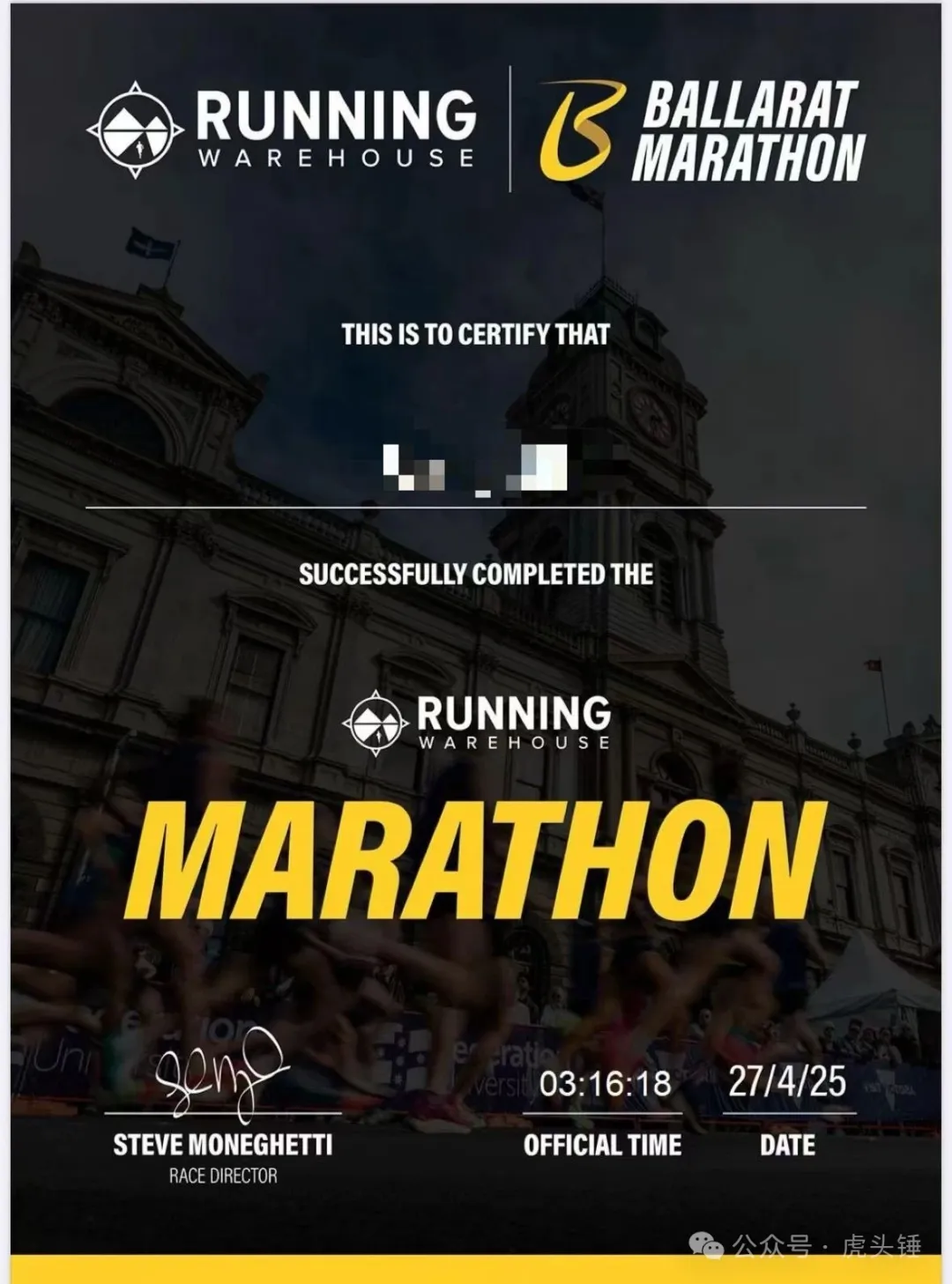
Six months later, he completed his first full marathon: three hours and fifty minutes. On his first attempt, he broke four hours.
The next year, he improved his time to three hours and fifteen minutes.
After thirty-five kilometers, it's impossible not to be tired. But by controlling his heart rate and maintaining his rhythm, he could slow down but never stop—without relying on willpower.
He often went out before dawn. The streets were empty, and the sound of his shoes hitting the ground was clear. After the run, he would return home just as the kids were waking up, and he would casually warm a glass of milk and put it on the table.
In running, he found a new order: science replaced brute force, and regularity replaced burnout. Unexpectedly, sticking to running allowed him to stop taking medication for premature heartbeats.

Perfectionism in the Construction Site
After buying a house, he became obsessed with renovation.
The house often looked like a construction site. While the kids did their homework, he wore safety goggles and chipped tiles in the bathroom, listening to storytelling podcasts as he worked.
He could paint and replace pipes with impressive skill. But he wouldn't go up on the roof. The two-story glazed tiles were too high and too slippery.
"You only live once, so I'll pass," he said.
His principle was "do what you can, and refrain from what you can't." What he could do, he had to do properly; what he couldn't do, he still needed to understand the principles.
When renovating his own home, the bathroom waterproofing had to be done by professionals. Although he couldn't do it himself, he carefully studied AS3740—the Australian standard for waterproofing domestic wet areas—and inspected every critical point of the construction. Sometimes he could even give pointers to the workers.
"Life must not be sloppy." That was his reason for being meticulous.
Like a Dandelion
When I asked him, "What does drifting mean to you?" he paused and gave a special metaphor.
Drifting is like an external stimulus. For example, plants placed in space can mutate; it's also like a dandelion, whose seeds are blown by the wind, not knowing where they will land. You don't know if you'll be blown onto fertile soil or into a ditch. But at least you've given yourself a chance to mutate.
Wherever you land, the lucky ones can continue to grow, and the unfortunate may break. But the moment the wind blows, the opportunity has already appeared.
In his view, immigration is not escape, but independence.
In Tianjin, if he had stayed with his parents, he might have remained a child forever.
In Australia, he had to face everything himself: taking IELTS, finding a job, supporting a family, running, renovating.
It was this process of "sink or swim" that allowed him to develop new abilities. "Some people never leave their familiar soil and live very stably. But that's too boring. I think what I want is opportunity."
A Final Resting Place in Feng Shui
During our conversation, he suddenly mentioned death.
"In Australia, I can be buried in peace."
He talked about a town called Eden, about five hundred kilometers from Sydney, where there is a well-known cemetery with lush green grass facing the sea. The sea breeze blows, and the tombstones stand quietly in the sunlight.
He said he was a bit superstitious, believing that being properly buried in the end is a blessing for one's descendants—a kind of feng shui. In his heart, immigration is not just about how he lives his own life, but also about whether his children and grandchildren can be protected.
On this unfamiliar land, he gradually built his own order, especially in work and family. These are the resting places of the living. And "being buried in peace" is the final destination he envisions.
Three Sides Form a Life
"Triangle Warrior" is the definition Cong gave himself.
In the process of finding a home, he didn't talk about grand ideals but concretely built three sides. One side is a DevOps engineer, another is a marathon runner, and the third is a DIY renovator.
Three sides, seemingly scattered, came together in him to form a complete life. Drifting did not break him; instead, it made him more whole.
In the last kilometer of a marathon, with the wind in his ears, his footsteps and breathing in sync, the finish line is right ahead. For Cong, that moment is not excitement, but calm.
His immigration journey is probably the same. Not relying on willpower to push through, but on scientific persistence, on being meticulous and not sloppy, on an unyielding spirit.
Drifting is not exile, but another form of growth. As for a final home, perhaps one day it will be like that cemetery in Eden, where even feng shui returns to tranquility.