Illustrated Ideas
Productive Impatience: A Mindset for Career Growth
 虎头锤 (Hutouchui) · Staff Engineer
Translated from the original Chinese essay · Read the Chinese original →
I often save good articles I come across, thinking to myself—this one I need to share when the time is right. Today I want to talk about an article I recently read by Steve Huynh, titled The Art of Productive Impatience, which I prefer to translate as "高效不耐烦" (productive impatience).
Steve's background is quite interesting: a former Amazon Principal Engineer, now a YouTuber focused on helping technical people grow quickly. His channel is highly recommended—packed with information and especially suitable for job seekers.
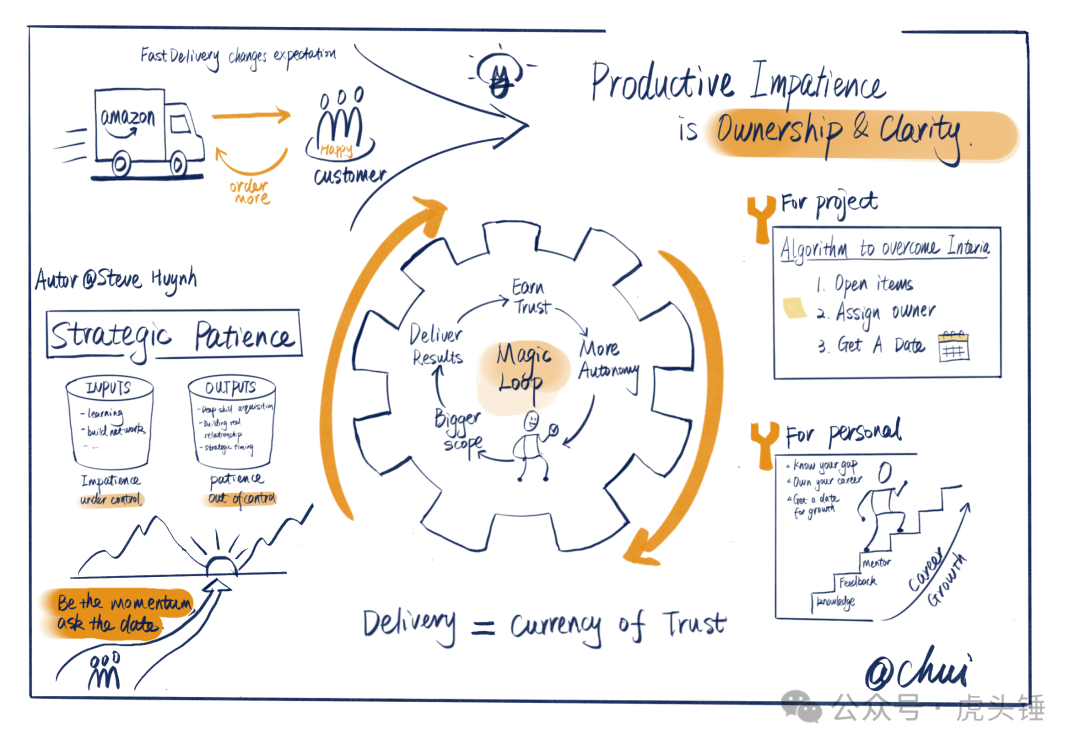
The opening example in the article is particularly striking. When Amazon introduced "two-hour delivery," it completely shattered the old assumption that online shopping meant waiting a week. Once people got used to that speed, slowing down became unacceptable. Behind it was not magic, but an overall improvement in software, processes, coordination, and infrastructure.
The key point is this: Amazon didn't passively follow; it actively raised efficiency to a new level, causing others' expectations of it to rise accordingly. This attitude of "actively reshaping expectations" is productive impatience.
Many people misunderstand "impatience" as being aggressive, but that's not it. The impatience here is about taking ownership of results, a form of high agency. It works like a small algorithm that helps us overcome inertia in projects, making responsibility and clarity visible.
Steve also introduced a concept I really like: the Currency of Trust. When you deliver results, you earn trust. With trust, you can gain more room to maneuver and greater opportunities for growth. Over time, it forms a cycle: delivery → trust → greater autonomy → a bigger stage.
So how do you apply "productive impatience" in a project? He gives a simple three-step approach:
- Clarify action items: identify the "long poles" or blockers on the critical path.
- Assign owners: every action item must have a single owner.
- Get dates: if there's no date, ask for a "date for a date."
This method reminds me of the pitfalls I often fall into when running projects. Everyone has meetings, but no one truly takes responsibility, or there's no concrete timeline. Eventually things drag on, and the project naturally slows down.
The same applies to your personal career.
- Action items: figure out what skills you need to develop for promotion or growth.
- Owner: it's you, but involve your manager and mentors for support.
- Dates: based on the results you've delivered, you have the right to ask, "When can we discuss my promotion?"
Of course, not everything can be driven by "impatience." In practice, you need to distinguish between inputs (things you can control, like learning, delivering, and expanding your network) and outputs (things you can't directly control, like promotions and influence).
- For inputs, be productively impatient—don't procrastinate.
- For outputs, be strategically patient—wait for the right timing.
"Productive Impatience" in a Technologist's Daily Life
For example, when writing code, you find that test data is always hard to come by. Instead of silently complaining, immediately write a small script to automate test data generation. While others are still manually assembling data, you've already saved half a day.
Another example is code review. Many people glance at the code and click Approve, but the "productive impatience" attitude is: since you've spent the time reviewing, go ahead and offer a couple of suggestions that would make the code more maintainable. These small investments, over time, will make others think, "I can trust them with this."
Also, project communication. You know a requirement is ambiguous, but you think, "Let's just start and see." A productively impatient person would immediately pull in product and design to clarify which version is actually expected. This step may seem like a hassle, but it avoids the much bigger hassle of rework later.
My biggest takeaway from reading this is:
Productive impatience is not restlessness; it's a stance. It makes others redefine their expectations of you. You're not just "waiting for opportunities"; through proactive delivery and pushing, you make opportunities come to you.
Of course, the highlight of this article is that I've picked up my hidden skill again. I bought a new iPad and Apple Pencil a while ago—can't let them sit idle.