CHAPTER 04
The Associative Machine
Read It
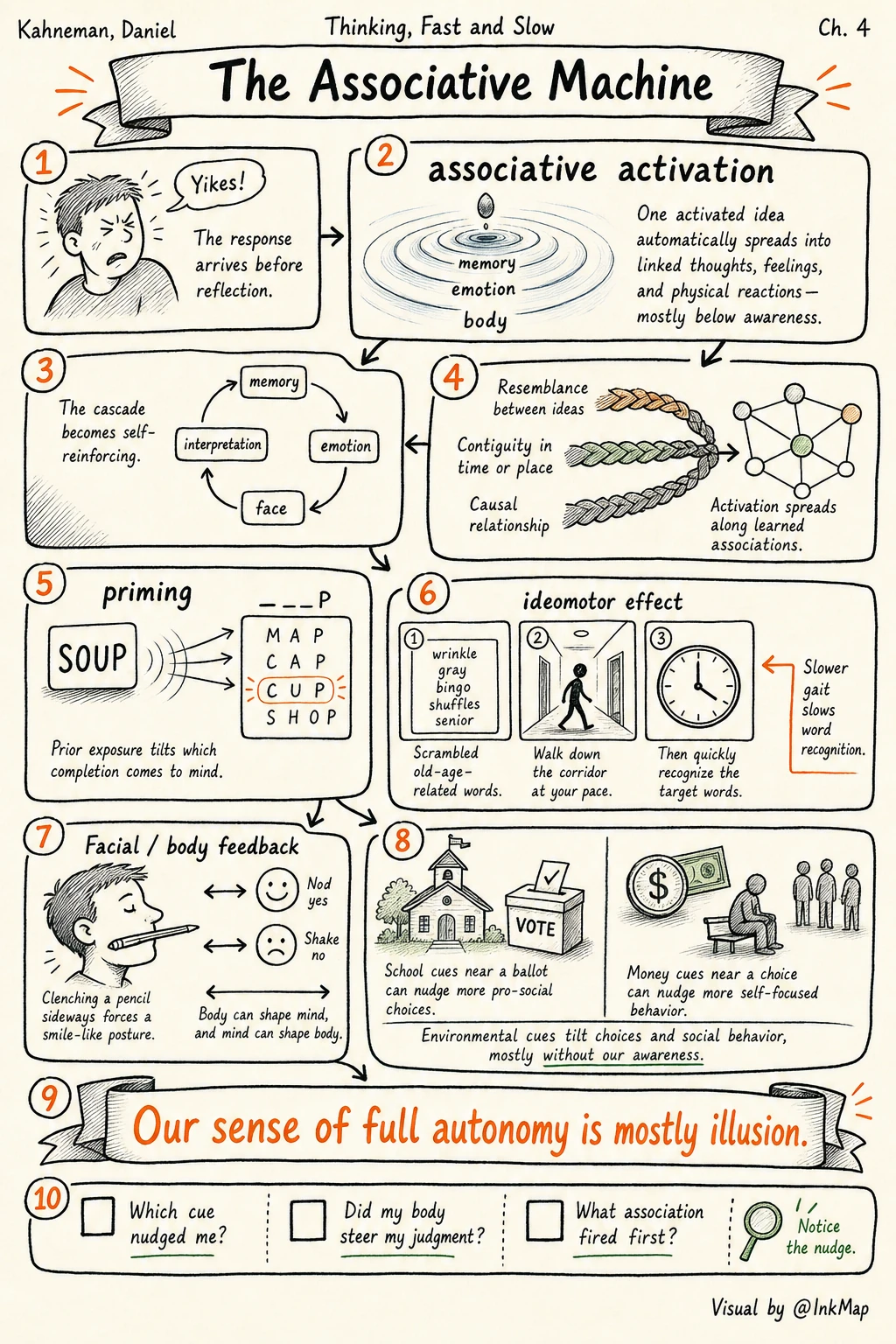
The unsettling thing about associative activation isn't that it changes judgment. It's that it happens entirely outside awareness. One evoked idea instantly pulls in memories, emotions, facial expressions, and bodily reactions, forming a coherent automatic response. Voting in a school makes people more supportive of education. Walking slowly primes the concept of aging. Holding a pencil between your teeth makes cartoons funnier. These effects are real, but every subject insists they weren't influenced.
 Open full image ↗
Draw It
In prose, the hardest distinction is between association and reasoning. Association is automatic, multidirectional, and unconscious. Reasoning is effortful, linear, and requires System 2. Once I separated these layers, the causal chain became clear: environmental cues trigger associations, associations change bodily states and emotions, and emotions shape judgments and behavior. Every step on this chain happens outside awareness, so the reasons people give afterward are often rationalizations, not real reasoning. Priming effects can flow in both directions between words, behaviors, bodily states, and facial expressions. That multidirectionality has to be drawn, or you'd think association is just about conceptual similarity.
Rethink It
In an interview, a candidate's first impression colors how every later answer gets interpreted. If the interviewer forms a "this person is good" association in the first few minutes, System 1 will automatically spin every technical answer in a positive direction. That's not the interviewer being unprofessional—it's the associative machine running in the background. What we can do isn't pretend there's no bias. It's using a structured scoring sheet to force System 2 to intervene and take some of the judgment back from intuition.
Take It With You
The associative machine never turns off, but I can give it checkpoints. Real reasoning has to pass through System 2's review. Otherwise, it's just post-hoc rationalization.