CHAPTER 03
The Lazy Controller
Read It
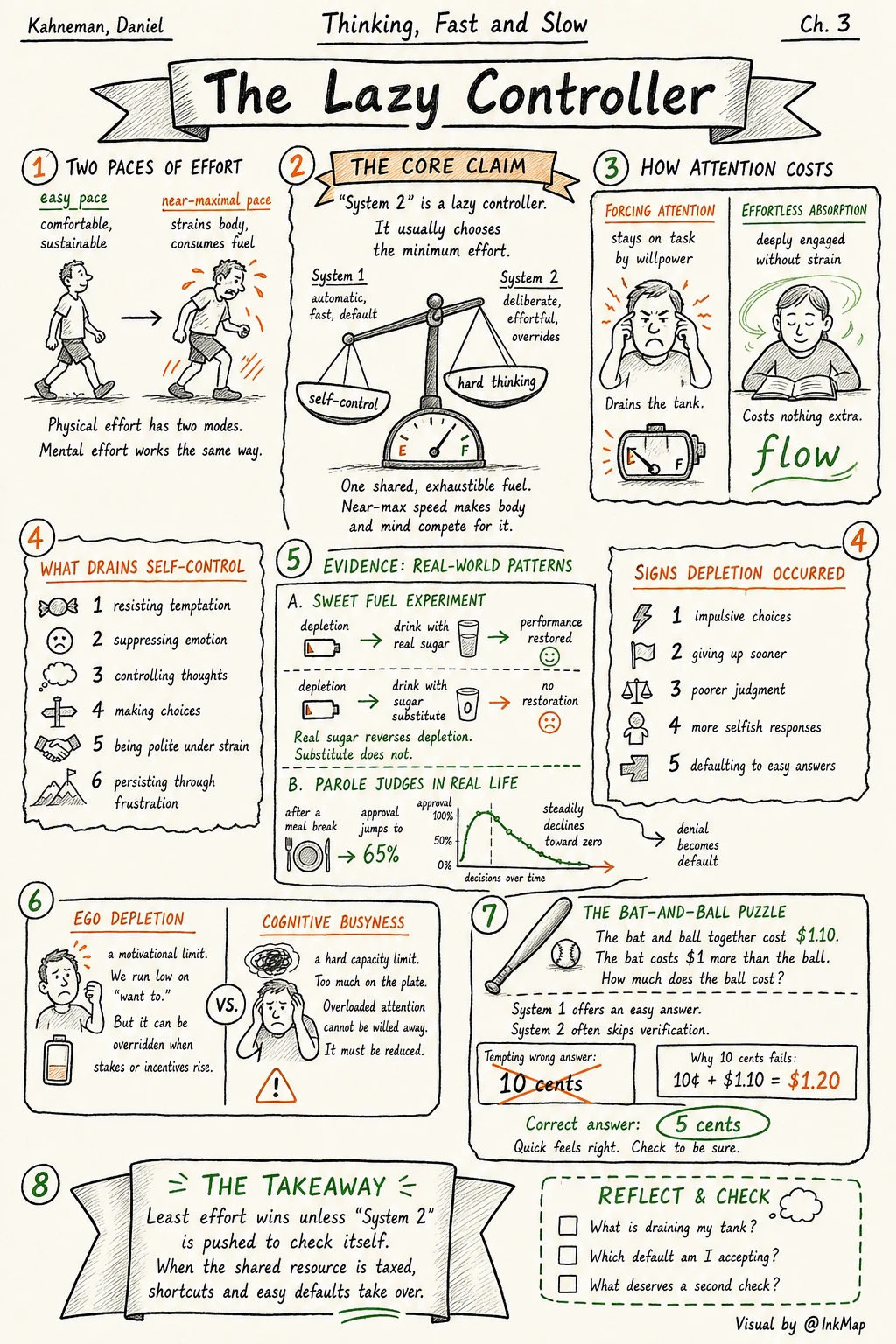
System 2 isn't absent—it just tires too easily. This chapter makes the lazy controller concrete: cognitive busyness and ego depletion share the same energy budget. The first is nearly impossible to overcome by effort; the second is essentially a motivation problem that can be temporarily reversed with enough incentive. The parole judges are the sharpest example: approval rates drop sharply before meals and recover after. It's not that judges are unprofessional. It's that once System 2's resources are drained far enough, System 1's intuitions take over the judgment.
 Open full image ↗
Draw It
The word "tired" is too vague. In prose, cognitive busyness, ego depletion, and blood sugar levels blur together. Following the structure in the diagram, the boundary between two mechanisms becomes clear: cognitive busyness is short-term memory being occupied; ego depletion is the aftereffect of earlier self-control. The first is nearly impossible to overcome; the second can be reversed with incentives. Blood sugar is the physiological link between them, proving that "mental energy" isn't just a metaphor. Flow is the exception—it shows that high-intensity engagement doesn't cause depletion as long as the activity doesn't require extra attention control. That exception needs to be marked separately, or you'd wrongly assume all intense tasks drain System 2.
Rethink It
Scheduling the most judgment-heavy meeting right after lunch isn't fussiness—it's respecting System 2's resource curve. If someone on the team makes several high-stakes decisions in a row and then rubber-stamps the last review, the problem may not be attitude but depleted resources. What a manager can do isn't demand more effort. It's spreading key decision points apart, or using process to force System 2 back online.
Take It With You
System 2's laziness isn't a character flaw. It's a default strategy under resource constraints. Rather than blame it, I'd rather design environments that make it less tired.