CHAPTER 02
Paradigms and Principles / A New Level of Thinking
Read It
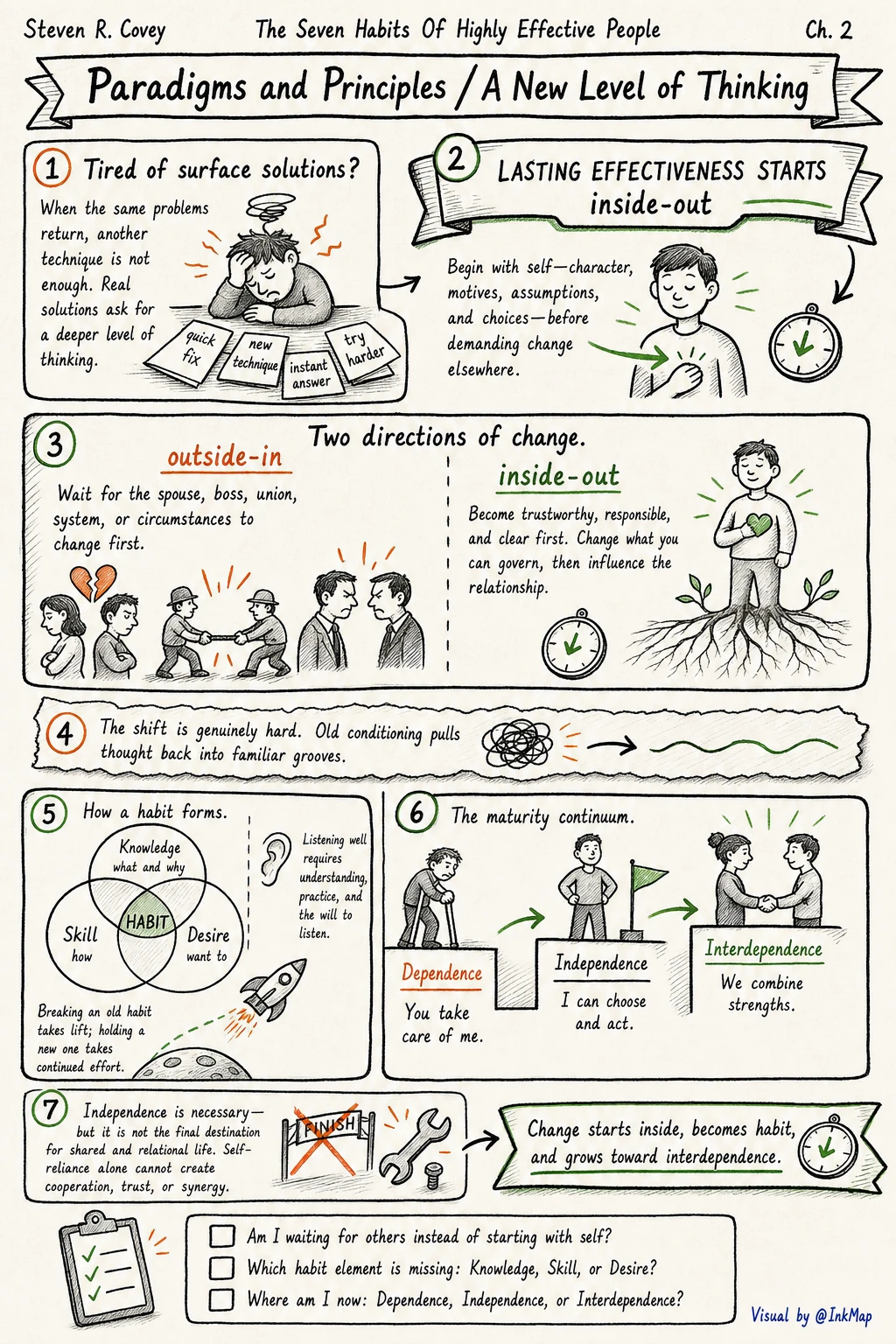
Independence is often treated as the finish line of maturity: not needing anyone, solving your own problems, taking responsibility for yourself. Covey places it in the middle of the growth path instead. Dependence means "you take care of me." Independence means "I can take care of myself." Interdependence means "we are each whole, and we choose to create together." It's not a retreat into dependence. It's having the option to stand alone and still choosing to collaborate. That distinction explains why some highly capable people struggle to accomplish anything large with others. The chapter also introduces habits as the convergence of knowledge, skill, and desire. Knowing what to do and why isn't enough. You also need to know how, and you need to actually want to pay the cost of change. Breaking an ingrained habit takes a strong initial push, like escaping gravity—but that same force can later stabilize the new behavior.
 Open full image ↗
Draw It
Dependence, independence, and interdependence form a maturity continuum, not three personality labels. Layering the habit model—knowledge, skill, desire—on top shows that growth requires all three at once. Once the levels are separated, "I don't need anyone" stops automatically reading as strength. It might just be a stopping point before the harder work of interdependence.
Rethink It
The person on a team who can deliver most independently isn't necessarily the one who can move cross-team work forward. Interdependence asks him to keep his judgment while allowing his solution to be changed by others. He has to own his part and also accept that the outcome depends on people he doesn't control. That's one more layer of uncertainty—and one more layer of possibility.
Take It With You
Independence gives you choices. Interdependence determines whether those choices can connect with the strength of others.