CHAPTER 01
Inside-Out
Read It
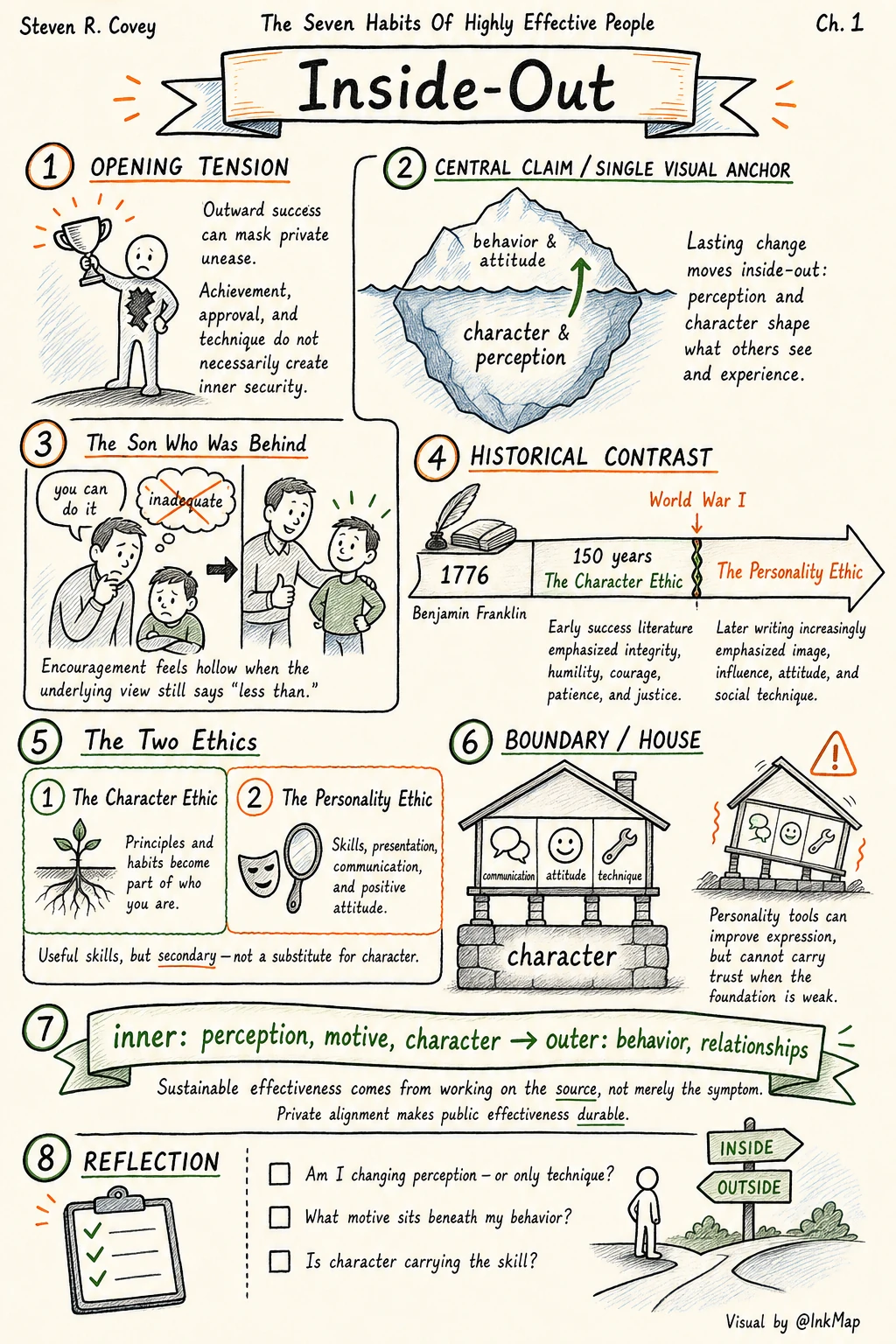
When a relationship or a life situation keeps producing the same pain, the natural move is to find a better phrase, a smarter method, or a technique that will finally change the other person. This chapter pulls attention back to the observer. Maybe what needs correcting first isn't the behavior but the lens through which we see the other person. Covey's story about misjudging his son makes the point sharply: no new coaching technique helped until he shifted his underlying perception of who his son was. Technique isn't useless, but when the inner motive is still control, proof, or fixing someone, technique only smooths the surface while the problem stays put. The historical contrast between the Character Ethic and the Personality Ethic shows this isn't a new tension. After World War I, success literature drifted from principles like integrity and courage toward image and social skill. Covey isn't rejecting those skills outright—he's saying they only become reliable when built on a foundation of genuine character.
 Open full image ↗
Draw It
The Character Ethic and the Personality Ethic aren't two parallel sets of advice. One is the root, the other the branch. Mapping them makes the causal chain visible: paradigm, motive, behavior, result. External techniques operate at the end of that chain, but lasting change has to start much deeper. It also clarifies that "inside-out" doesn't mean blaming yourself for everything. It means identifying the part you can actually take responsibility for.
Rethink It
When a collaboration keeps hitting the same conflict, we usually change the wording, add a process, or find a new communication template. But if you've already decided the other person is unreliable, even the best question carries an accusation. Checking your own assumptions first—then deciding whether to change behavior, set a boundary, or end the relationship—gets closer to the real problem than endlessly optimizing your phrasing.
Take It With You
Real change isn't about getting more skilled at influencing others. It's about seeing clearly how you understand them in the first place.