CHAPTER 05
Writing engineering strategy
Read It
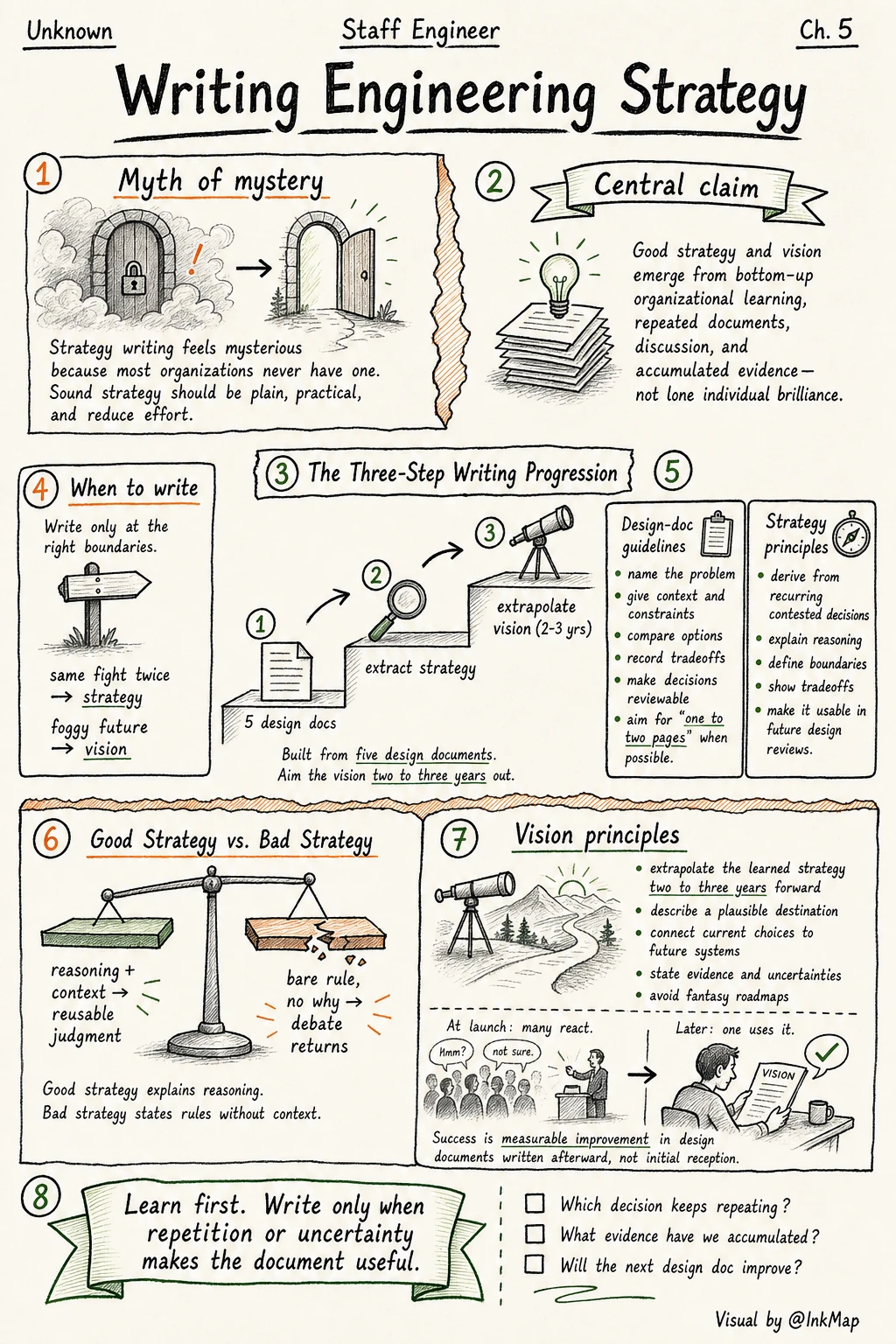
Engineering strategy gets a bad reputation because most of it reads like a list of good intentions: improve reliability, increase reuse, build a world-class platform. The problem isn't the prose. It's that the reasoning has been skipped. A strategy that appears fully formed, with no visible connection to the decisions a team has already made, is impossible to argue with and impossible to act on. The chapter's real insight is that strategy and vision are not acts of invention but acts of extraction. You write design documents first, notice the trade-offs that keep recurring, and only then name the pattern. Vision comes later still, extrapolated from strategies that have already proven themselves. Reverse that order and abstraction loses its anchor, leaving behind slogans nobody can oppose and nobody can execute.
 Open full image ↗
Draw It
Design documents, strategy, and vision sit at three different altitudes. Design documents preserve specific decisions. Strategy distills the judgment that repeats across them. Vision describes where those judgments point over time. Drawing them as a bottom-up path of refinement makes the sequence visible: disagreements should surface in the details first, and a strategy with a position is different from a strategy that only issues rules. The visual also exposes the trigger conditions—write strategy when a team keeps re-debating the same decision, write vision when future uncertainty makes prioritization unclear—so the whole process stops looking like a rare gift and starts looking like a repeatable discipline.
Rethink It
A useful strategy review asks three questions: Which design trade-offs does this come from? Why was this path chosen under the current constraints? What would a future engineer use to revise it when conditions change? If those questions have no answers, the most elegant vision won't guide the next design document. The reverse also holds: when a strategy is hard to write, returning to the last few concrete decisions usually helps more than searching for grander wording. Teams don't need more principles; they need the reasoning behind the positions they're already taking.
Take It With You
Strategy is not the ability to imagine the future. It's the ability to extract reusable judgment from specific choices. A vision without the support of detail is just a wish with more confident phrasing. The measure of success isn't whether people applaud the document when it's introduced, but whether the quality of subsequent design decisions visibly improves.