CHAPTER 02
What do Staff engineers actually do?
Read It
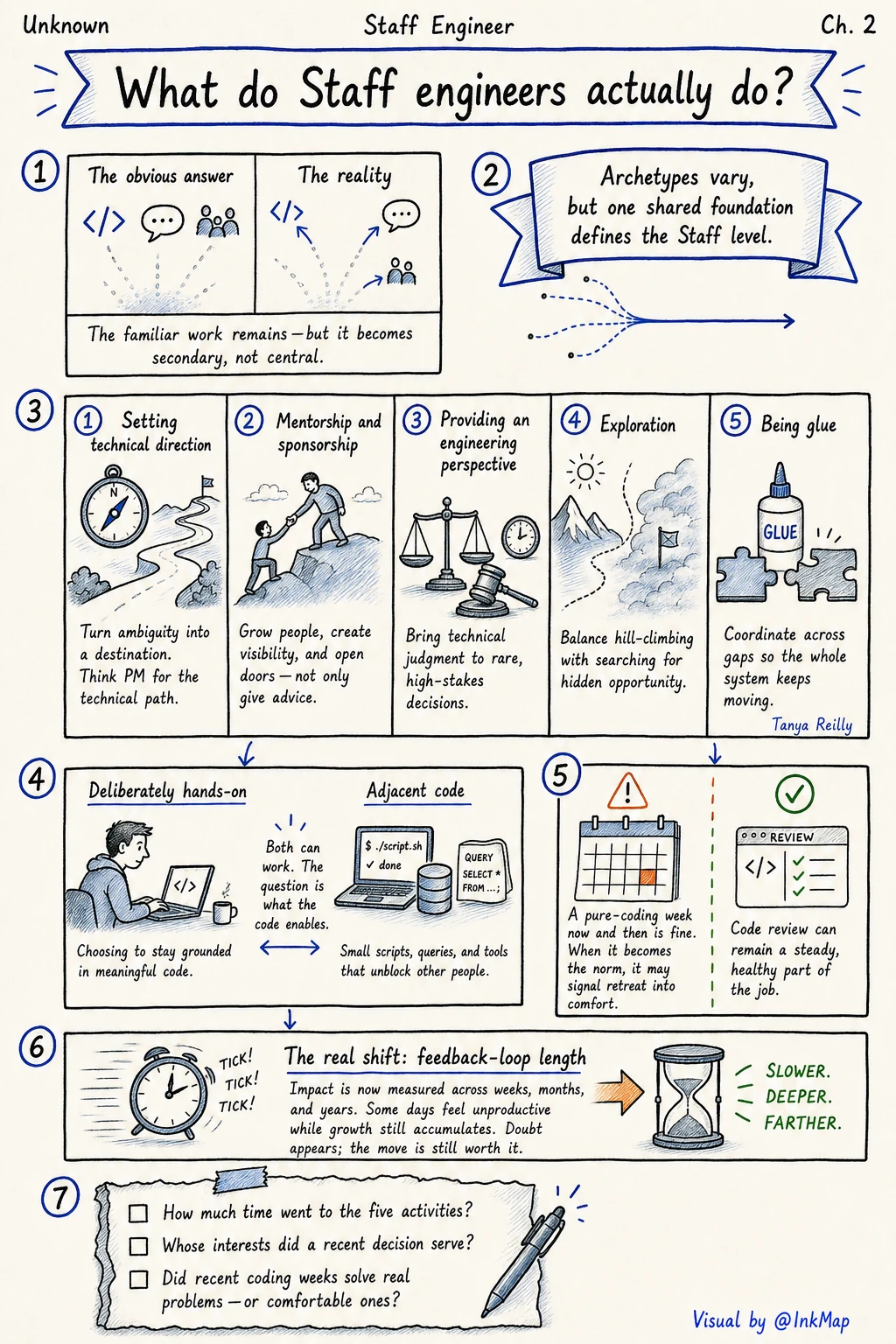
The reason Staff engineer work is hard to list isn't that it's mysterious. It's that a priority inversion has happened. Writing code, leading people, and driving projects haven't disappeared—they just no longer define the role. What actually takes over your attention is setting direction, mentoring and sponsoring others, bringing an engineering perspective into organizational decisions, doing exploratory work, and connecting teams that would otherwise stay siloed. They share one more trait: longer feedback loops. Code can run the same day. Whether a direction was right might only show up two years later.
 Open full image ↗
Draw It
The five categories aren't parallel tasks. They're a mutually supporting structure of influence. Direction needs exploration as input, and it needs an engineering perspective to enter decision-making. Sponsorship and glue work keep direction from staying locked inside one person's judgment. Placing them on different time scales and risk levels is what makes visible why Staff work isn't simply "less coding, more meetings."
Rethink It
If a quarter is almost entirely coding, there's no need to rush to prove it's not senior enough. But it's worth checking: are there direction-setting judgments, cross-team coordination, or sponsorship opportunities that only you could take on, and that got crowded out by the more certain work of coding? Coding gives fast feedback and a sense of completion. The hardest part of senior work is continuing to calibrate direction when the results aren't yet visible.
Take It With You
The core skill of Staff isn't doing more things at once. It's accepting longer feedback cycles and giving limited attention to judgments with a wider blast radius.