CHAPTER 01
Staff Engineer Archetypes
Read It
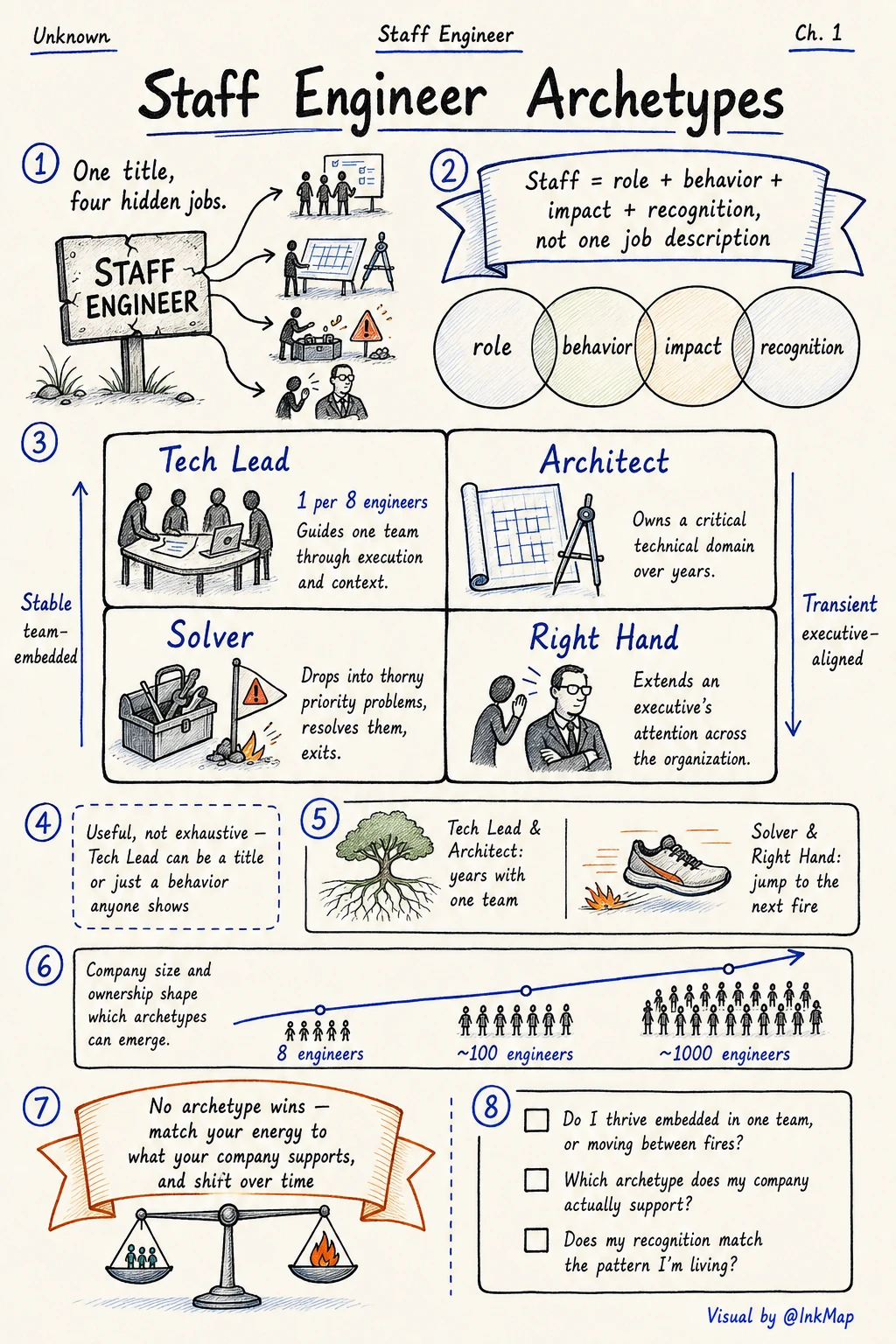
A single "Staff engineer" title creates the illusion that there's one standard template—just check off the competencies and you'll become that person. In reality, Tech Lead, Architect, Solver, and Right Hand serve four different organizational functions. Some create impact through team breakdown and delegation, some guard long-term technical direction, some attack high-risk problems, and some push cross-cutting issues through an executive's authority. They aren't ranked by ability, and the choice shouldn't start from which one sounds more senior. It should start from where your energy comes from and what the company actually needs.
 Open full image ↗
Draw It
The four archetypes need to be separated by work focus, mode of influence, and conditions for existence. Once they're placed in the same structure, "role" and "level" stop being confused: a Right Hand usually requires a larger organization, a Solver requires a culture that lets individuals own problems, and a Tech Lead depends more on team collaboration. Archetypes also aren't fixed forever—a person can shift as the organization changes.
Rethink It
The most common career-planning mistake is taking a successful Staff engineer's calendar and reverse-engineering your own growth path. You see someone in meetings all day, breaking down tasks, and assume you should also cut back on deep work. But if your company needs long-term architectural direction, imitating a Tech Lead's working style just creates misalignment. First look at what the organization lacks, then at what kind of problem you're willing to solve for a long time. Only then does the path make sense.
Take It With You
No Staff archetype fits every company, and no archetype is worth pursuing for everyone. The cost of choosing the wrong role is often greater than the cost of being promoted a year later.