STORY 05
A Flower Holds a World, A Thought Brings Rebirth
 虎头锤 (Hutouchui) · Staff Engineer
Translated from the original Chinese essay · Read the Chinese original →
This is the fifth piece in Wandering Under Different Stars (5/100).
On the morning of her second layoff, Michelle was in a regular meeting. The voice of the REA HR person on the phone was calm and professional, but it couldn't hide the cruelty behind it.
Many people ask her: Why do you always find your next job so quickly?
But she knows best that what truly keeps her steady isn't her resume or luck. It's an ability she has slowly cultivated over the years: holding onto her energy in the storm, and building order out of disorder.
This time, she chose to leave quietly, staggering her departure from other laid-off colleagues. No farewell party, no applause. Yet as she walked out of the office, her heart was calmer than during her first layoff.

The Road Here
Her immigration transition was remarkably smooth.
At the time, she and her husband were still working at Thoughtworks in Xi'an. The company sent them directly to Australia and arranged their work visas. Not long after, the work visa smoothly converted to permanent residency.
Many people struggle with their immigration status for years, but she barely took any detours. This stable starting point allowed her to focus entirely on her career. Yet precisely because of that, when the layoff came later, the shock felt sudden and fierce.
She is a typical small-town youth. Fortunately, her mother was resilient and had an almost stubborn dedication to education. A relatively turbulent childhood and her extreme sensitivity to the emotions around her made "insecurity" the underlying color of her life.
As an adult, she has always had a certain obsession with work, because losing it would mean falling back into a bottomless void. It is this fear that makes her especially eager for control and especially diligent in seeking stability.
When the second layoff came, she was able to stand firm in the storm precisely because over these years, she had slowly learned to repair herself.
Calming the Storm
After her first layoff, it took her a full year to recover. At that time, she was already pregnant with her second child. The company's project was halted, the CEO ran into trouble, and the entire team lost their jobs overnight. Although she quickly found a new job, when her maternity leave came, she would often stop suddenly while pushing the stroller, tears flowing uncontrollably. She would wake in the middle of the night, staring at the ceiling, repeatedly asking herself: Why me?
This time, when the same scene repeated, she did not immediately melt down, did not impulsively send angry emails, did not break down crying. What she did instinctively was open LinkedIn and start searching for jobs.
She knew she needed to protect her energy. She continued to pick up and drop off her children as usual, chatting with other mothers at the playground; she still went to Parkrun, even if only for a short run; she still cut fruit in the kitchen and talked about the weather with her family.
"A layoff is a war of attrition on your emotions," she says. "Energy and mindset matter more than your resume."
She avoided low-energy situations. The laughter of running children, the breath of early morning, the powerful people around her—all of these gradually replenished her energy.
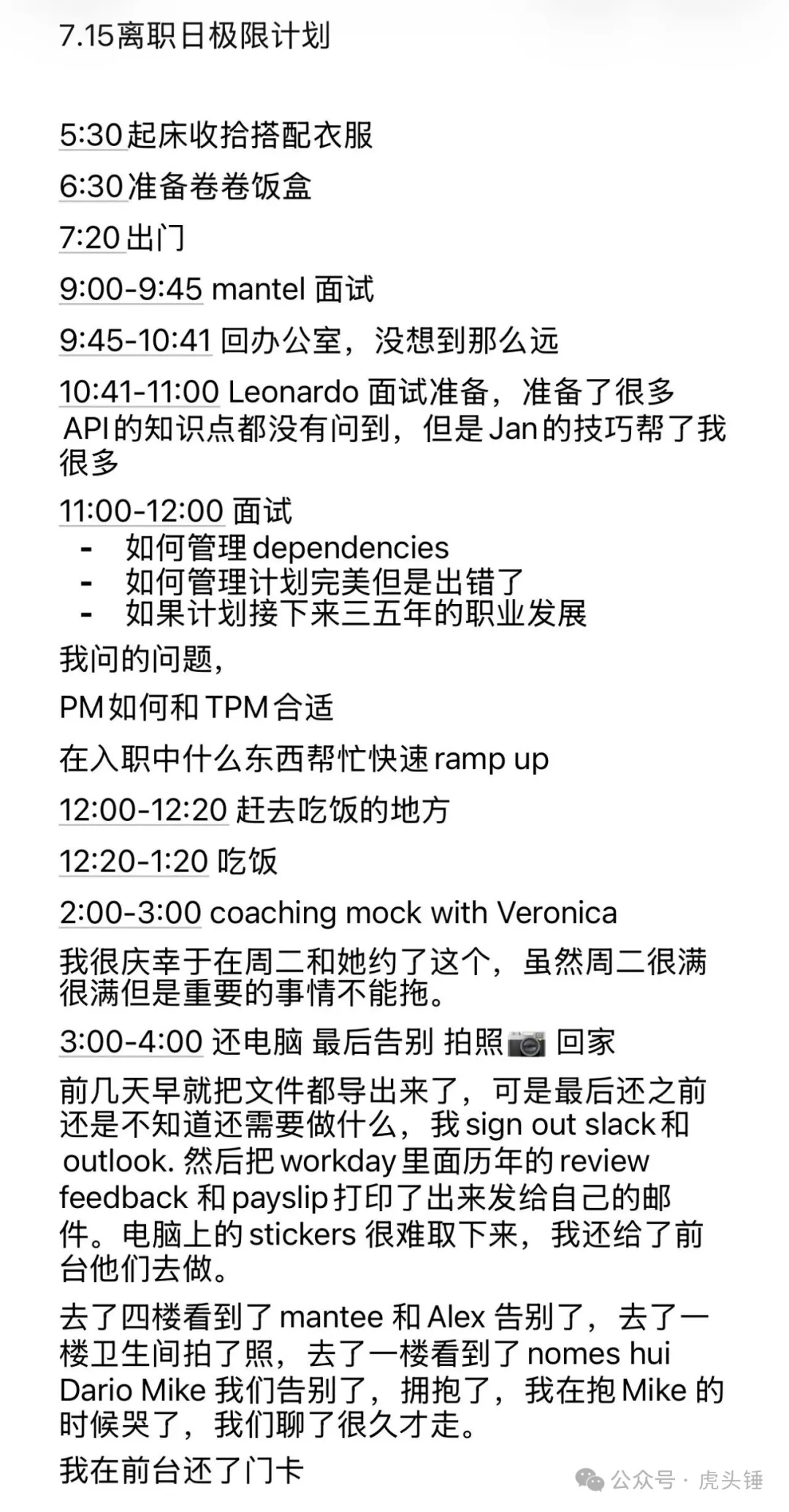
She even deliberately avoided the company's farewell moments. She had attended someone else's farewell before, and afterward her energy was completely drained for two days. At that moment she understood: rather than exhausting herself in goodbyes, it was better to save her limited energy for the future. So she chose to leave quietly. No applause in the office, no clinking glasses—just herself quietly packing up and walking out.
Untangling the Chaos
Once her mindset was steady, Michelle immediately shifted into her most familiar project-based mode. For her, this is a fundamental skill of a delivery lead.
Fifteen years of project management experience have made her accustomed to breaking down all uncertainty into stages and checklists. What others see as a vague "job search" became, in her hands, a set of "deliverables."
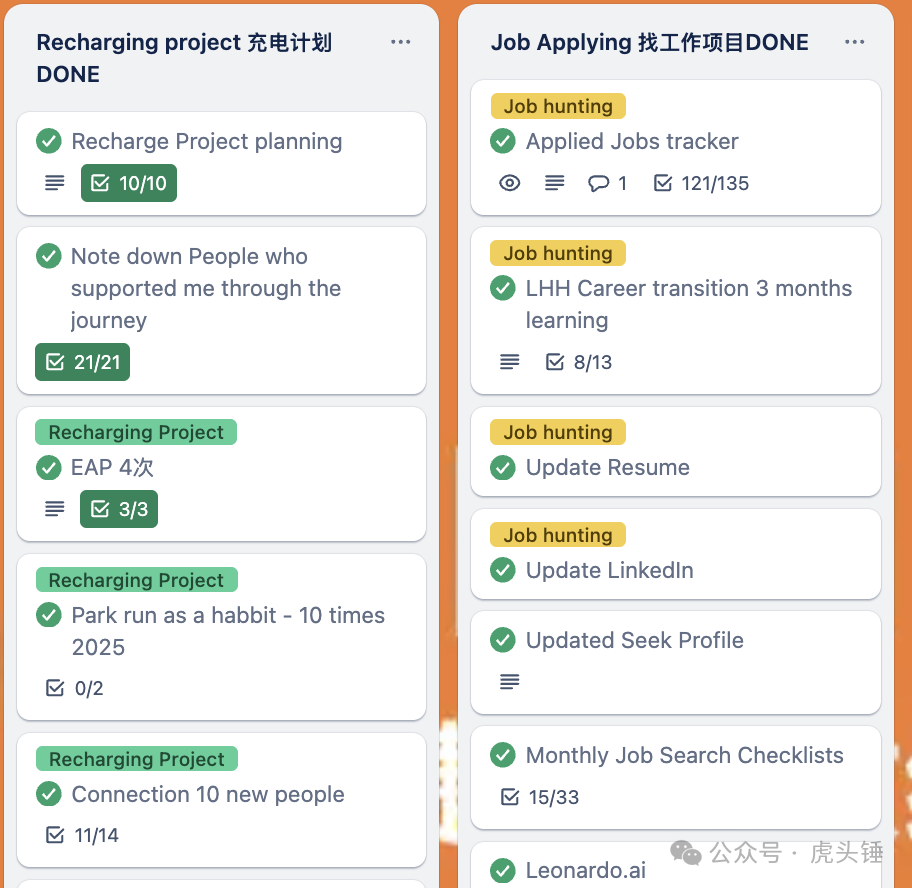
She first created a Trello board and divided the entire process into columns: collecting job postings, contacting referrals, submitting resumes, interview preparation, and follow-up on results. Each step became a small card. Every morning, she would spend fifteen to thirty minutes processing these cards: when she found a suitable position, she dragged it to the "submitted" column; when she received an interview notice, she dragged it to the "preparation" column. The small drag-and-drop action made her feel that she was not being pushed along by fate, but actively driving a project forward.
"Once submitted, cross it off. No procrastination allowed," she says. The sentence is as concise as the rules she sets for her team.
Entering the interview stage, she would set aside several hours of "deep work" time. Spread out on the screen were the job description, company background, and a list of possible questions. She used ChatGPT to batch-tailor her resume so that each one matched the JD seamlessly; she used the SOAR framework to rehearse stories, distilling the conflict, action, and result.
As she typed on the screen, it was like rehearsing a script. Except this time, she was both the actor and the director.
"AI doesn't think for me; it helps me get to high-value actions faster," she summarizes.
While others were still stuck in emotional fluctuations, she had already turned the job search into a rhythmic, productive delivery. Even if a resume was rejected or an interview failed, all she had to do was tick off the task and mark it as "completed." In her view, as long as the process moved forward, that in itself was a success. The feedback from failure also became positive motivation.
She calls herself a "pessimistic optimist"—always anticipating the worst-case scenario first, but always able to find order to keep moving forward amid the chaos.
You read that right. Besides the job search project, she also started a learning plan at the same time. That's part of her Trello board.
On weekends, she went shopping. Seeing the bustling streets and how beautiful life was, she thought: How could I not find a job? Opportunities are everywhere. She could work as a sales assistant in a store, do cleaning, or work in a coffee shop. Survival was never the problem; the only question was whether she wanted to stay on the IT path.
She also hesitated, wondering whether she should just take a break for a while. She specifically consulted a friend who had also experienced unemployment. The friend warned her: "Don't rest. Once you stop, the time will stretch longer and longer, and your mindset will change too."
Michelle took those words to heart. She silently told herself: If I haven't found a suitable job within three months, then the universe wants me to change paths. And doing something else then would be just as good.
During her job search, she also built a small tool on Replit called Job Tracker.
At first it was just an idea: Could she bring together the Trello process, resume submissions, and interview progress in one place? She discussed the idea with a friend, went back and forth through several versions, and finally made a lightweight application.
The tool wasn't complicated, but it gave her a sense of order amid the chaos. Even more unexpectedly, this small product became a showcase of her personal brand.
Watching the Sea of Clouds
But her preparation wasn't only rational.
She had a habit of walking into the yard before an interview, looking at the sky, the clouds, the dew on the grass tips, and touching the blooming roses.

"Nature is so vast, and a single person is truly tiny," she says. "Against that backdrop, I can relax and be myself in the interview."
So her interview rhythm was always steady: turn off notifications thirty minutes before, take deep breaths ten minutes before, and go online one minute before. When answering questions, she would first point out two or three key points, then pause briefly. She treated the interviewer as a guest sitting across the dining table, not an examiner.
At that moment, she was no longer the person being scrutinized, but a calm person telling her own story.
A Thought Arises
How could she do this? Because she had long since said goodbye to her past self.
In the years after her first layoff, she joined another company and encountered a toxic leader. Promises and denials alternated, praise and criticism coexisted, and prolonged psychological manipulation plunged her into self-doubt.
Under long-term pressure, her emotions spiraled out of control several times. One late night, she wrote a long email and almost pressed send. The next day she showed it to a friend, who said it was well written but advised her not to send it.
One day, a senior stakeholder chatted with her about feedback and casually drew a coaching model for her. In just one hour, it was as if a light had been lit in her heart. For the first time, she realized: rather than being trapped in others' evaluations, it is better to learn to talk to yourself.
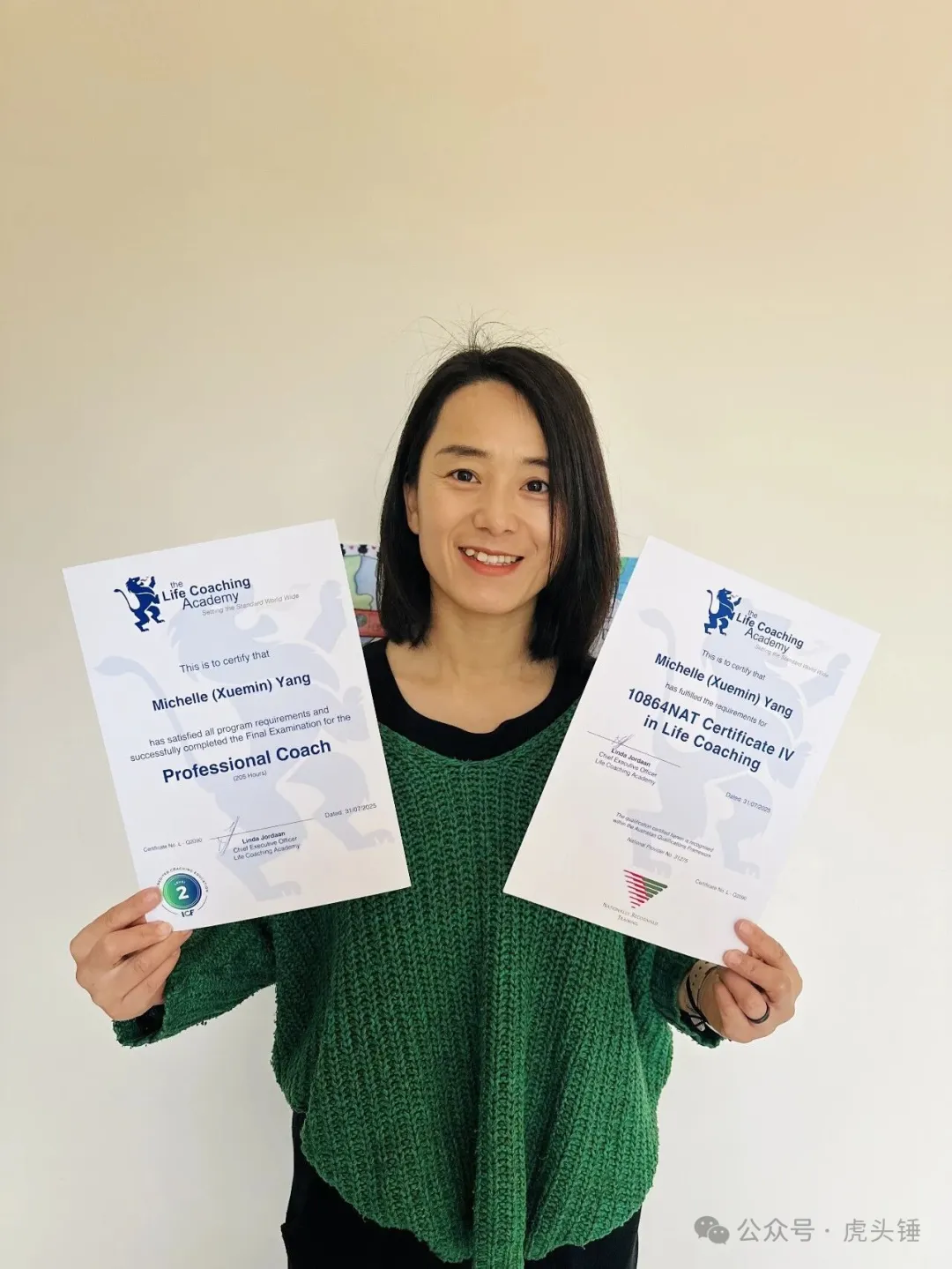
From then on, she began systematically studying life coaching and eventually earned an ICF Level 2 certification. She shifted her focus from "100 percent work" to "80 percent work + 20 percent growth." Running, reading, and community activities all became reservoirs of her energy.
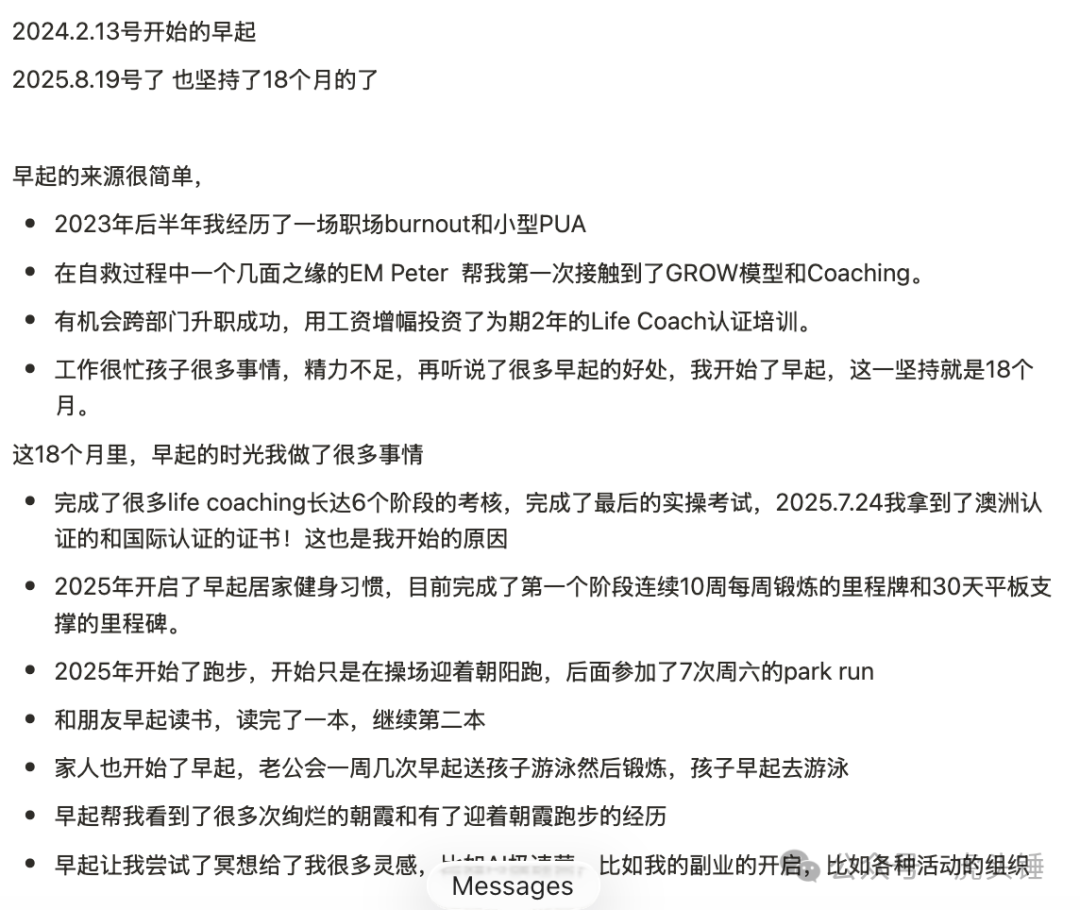
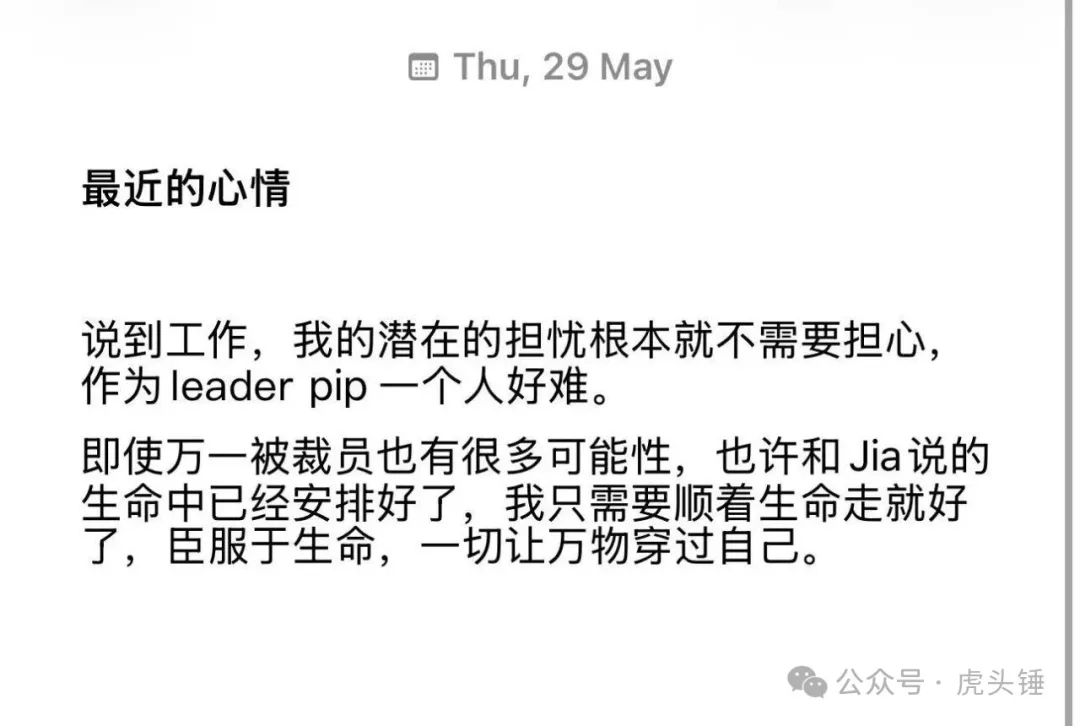
So when the second layoff came, she did not fall back into endless self-blame. She knew: losing a job is not losing yourself, and besides, she had long been prepared. On May 29 this year, two months before the layoff, she wrote in her diary about her recent mood. Even on the day she received the layoff call, she was still worrying about someone else's PIP.
Shared Lamps
Unlike many people who choose to shut themselves in their rooms, Michelle was organizing a small AI training camp while job hunting.
She first held a workshop at home, inviting fifteen mothers together, setting out fruit and tea, and demonstrating how to use AI to write emails, polish resumes, and manage schedules. Some were skeptical, some excitedly followed along, and the room was filled with laughter and exclamations, which made her feel very relaxed.
But she didn't stop at a "one-time gathering." She carried this enthusiasm forward and started a group chat named: No Tech Talk, Just Practical | AI Hands-On Growth Group. In the group, no one was just listening; everyone was practicing, making mistakes, and exchanging ideas.
Even more remarkably, she extended this online connection to offline (Melbourne). Every month, she organizes an AI meetup focused on workplace efficiency and practical case studies, using a format of guest sharing + coffee chat. She posts reminders in the group: "Please lock the time into your calendar first~"
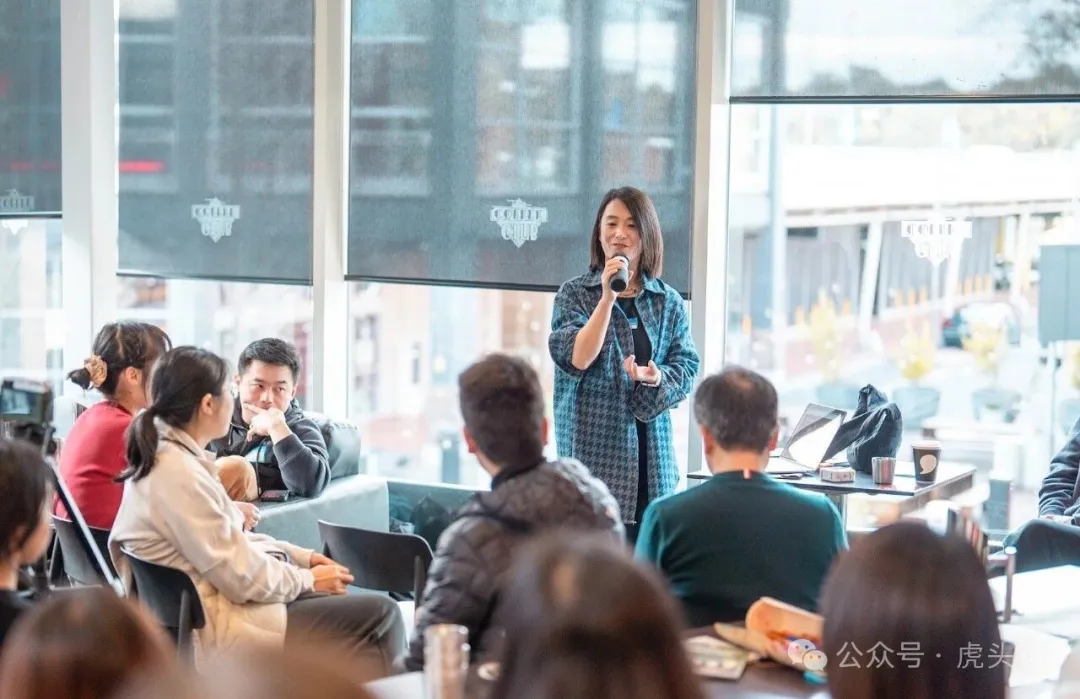
These events have no grand packaging; they are mostly practical sharing and real stories. Someone brings an AI productivity tool they tried at work, someone shares how they use AI to manage tasks. Everyone is both a participant and a contributor.
"Others might be anxious at home; I choose to go out," she says.
In this small community, she is no longer just a job seeker waiting for opportunities, but a person walking side by side with a group of people. She lights up others, and she also gains light from them. New ideas and new connections slowly emerge from such connections.
One lamp can light itself; many lamps light each other.
Seeing the Wider World
A few weeks later, she received a new job—a dream job offer.
That day, she didn't celebrate. Instead, she walked outside alone. The wind was a bit cool, the clouds parted, and sunlight fell on the grass. She took a gentle breath, and a clear voice rose in her heart: This is not repetition; this is a rebirth.
Michelle's story is not a job search guide. It is about how a person recognizes the scars from the past, anchors herself in the storm, brings order to chaos, and observes her own mind amid anxiety.
The most important moment is when a thought arises: deciding not to be defined by the past, deciding to light a lamp for herself and warm others, and ultimately, in the vast world, meeting a brand-new self.
She bent down to look at that dewdrop. Reflected in it was the entire sky, and also her own new appearance.
A flower holds a world; a thought brings rebirth. The greatest storm was never outside, and all tranquility ultimately comes from within.