Notes & Observations
All Mountains and Seas Can Be Leveled: What Zheng Qinwen's Victory Over Sabalenka Teaches Programmers About Breaking Through Technical Seals
 虎头锤 (Hutouchui) · Staff Engineer
Translated from the original Chinese essay · Read the Chinese original →
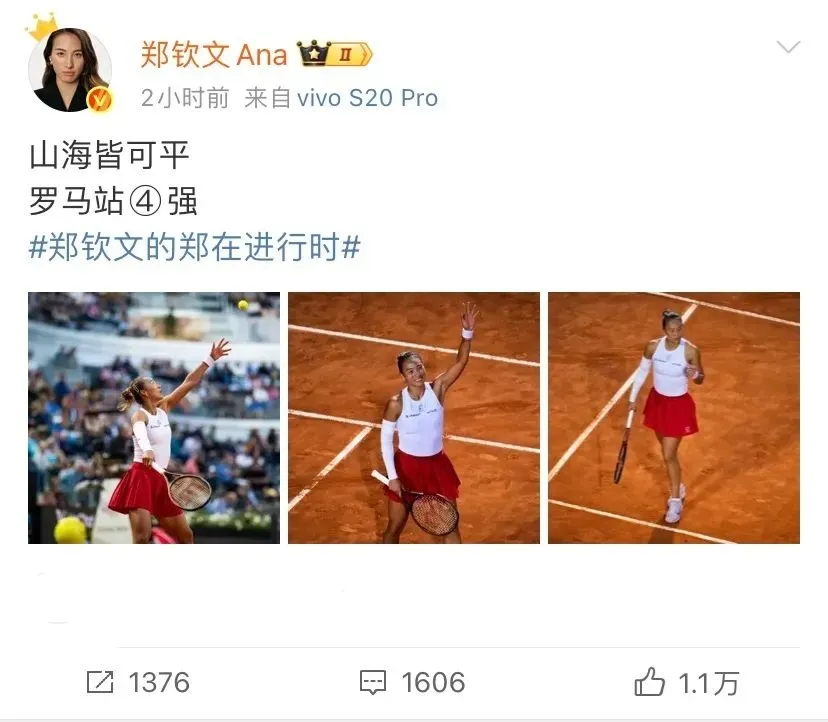
On May 15, at the Rome 1000 tournament, Zheng Qinwen defeated world No. 1 Aryna Sabalenka 2-0. The score was clean: 6-4, 6-3.
She had lost all six previous meetings, but this time, she won.
And here I am, staring at my deployment pipeline, which failed again. Which configuration is wrong this time?!
- The Programmer's "Sabalenka"
Have you ever encountered a problem like this?
A bug you've fixed three times, yet users keep finding issues (don't even mention it—the more you talk, the more tears).
A piece of legacy code no one dares to touch; every requirement change feels like dancing in a minefield.
A technical proposal you've presented three times, each time rejected by someone more "senior."
Over time, you start to believe: "This problem is unsolvable."
Just like Zheng Qinwen in her first six matches against Sabalenka—she wasn't lacking effort, but every time she was overpowered by her opponent's heavy serves and violent forehands. In the post-match interview, the reporter asked: "What do you find most difficult about her?" Zheng Qinwen didn't complain that "the opponent is too strong." Instead, she said: "There are still many things I haven't done well. Next time I'll try a new strategy." Translated into programmer language, that is: "I haven't fixed this bug yet, but I'll debug it a few more times and try to cover all scenarios."
- Real Breakthroughs Are Not Miracles, but Compound Interest
Where did Zheng Qinwen win this time?
- First serve success rate 75% (previously only 60%)
- Baseline return success rate close to 60% (previously suppressed to 40%)
- Varying pace and placement (no longer going head-to-head)

It wasn't some "talent explosion," but rather adjusting strategy and executing details.
Earlier this year, I optimized a process. Only after reviewing the entire flow from scratch did I realize the real bottleneck wasn't in the code layer, but that the dashboard we were using completely ignored AWS Lambda cold start times and gave us incorrect benchmarks. Several lambdas added up to over four seconds—no wonder users complained about slowness while we said the data looked fine.
This isn't a miracle; it's compound interest. Zheng Qinwen practices 300 serves a day, but a match only needs 10 good serves. As a programmer, you write 100 lines of code, but maybe only 10 are on the critical path. But without those 90 lines of elegant error handling, the system will still crash.
- The Technologist's "Break Point"
The most thrilling moment in a tennis match is the break point—when the opponent needs just one more point to win the game, and you must withstand the pressure and turn it around.
What is a programmer's "break point"? A production incident, with everyone on the call waiting for you to fix it immediately.
When Zheng Qinwen faced break points this time, her save rate was 72% (WTA average 56%). She didn't rely on luck, but on:
- Anticipating the opponent's shots (analyzing logs)
- Adjusting her shot strategy (optimizing logic)
- Executing steadily (not panicking, not forcing it)
This is exactly the same logic as fixing a bug: reproduce the issue (check logs, capture requests); locate the root cause (is it cache? locks? multithreading?); fix it steadily (don't rush to patch; think it through first).
- Refactoring Is Not Overthrowing, but Evolving
Zheng Qinwen's biggest change this time was that she no longer let her opponent dictate the pace.
Previously, Sabalenka's heavy groundstrokes could pierce through her defense. This time, she used slices, changes of direction, and drop shots to bring the match into her own rhythm.
When programmers face legacy systems, they often fall into two extremes: not daring to touch it (continuing to patch until the system becomes a "mountain of shit") or overthrowing everything (refactoring for six months, then crashing on launch).
But Zheng Qinwen tells us: true stability is not about staying still, but about being able to move without chaos. Software systems must evolve in an orderly way to truly deliver value to users.
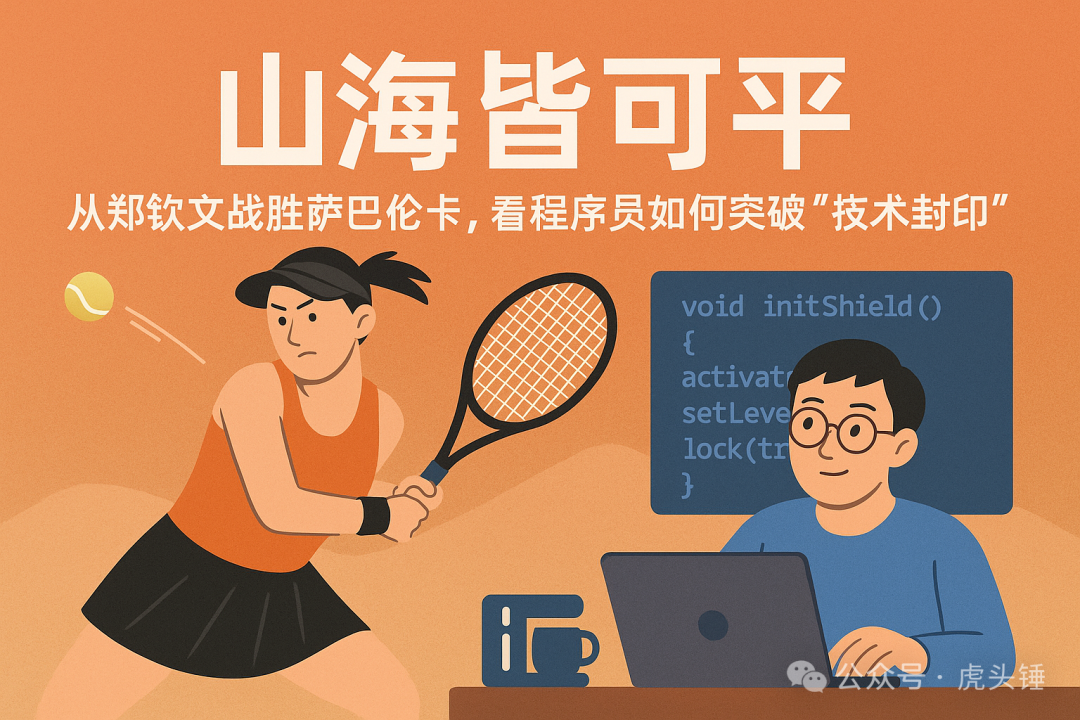
- All Mountains and Seas Can Be Leveled—Not Chicken Soup, but an Attitude Toward Work
Zheng Qinwen's victory was not decided at the moment she stood on the podium. It was decided by the extra five sets of shuttle runs during physical training; the two-degree adjustment of her racket face during serve practice; the extra half hour of watching opponent tactics during video analysis.
A programmer's breakthrough is also not the moment of eloquent speaking at a tech conference. It is: at 2 a.m., when you finally capture the reproduction conditions for that intermittent bug; on a weekend overtime, when your refactored code passes all test cases for the first time; in code review, when a colleague says, "This design is clever."
The real victory is proving that those sleepless nights were not in vain.
And what truly levels mountains and seas is never the tools, but the determination to stay in the game when facing problems.