Interviews
Rejected Three Times, Then Rewrote My Resume with AI and Landed a Big Tech Offer
 虎头锤 (Hutouchui) · Staff Engineer
Translated from the original Chinese essay · Read the Chinese original →
At 1:30 a.m., Shen Nan stared at her computer screen, the cursor blinking on her resume as if mocking her incompetence.
This was the third time she had been rejected by a big tech company.
Eight years of experience, distributed systems, team leadership, core projects—her resume clearly said "I'm strong," yet HR wouldn't even give her an interview.
"What exactly is the problem?" she bit her lip, her fingers unconsciously tapping the keyboard.
She had tried everything: grinding coding problems, memorizing interview experiences, asking friends to revise her resume, even spending a fortune on job-hunting bootcamps. The result? Only cold automated replies in her inbox.
Until that day, when she came across a post:
"Using AI to revise your resume might be more effective than revising it thirty times yourself."
She scoffed: "Can AI understand my experience better than I do?"
But out of desperation, she opened ChatGPT, uploaded her resume, and typed the first line:
I am a software engineer with eight years of backend development experience, mainly working with Java and Spring Boot, and I want to apply for senior engineer positions at top-tier companies. Can you help me write a resume summary that highlights my project experience and tech stack? Here is the version I currently have: 'I am good at writing code, can solve problems, and love technology.'
Ten seconds later, a paragraph appeared on the screen:
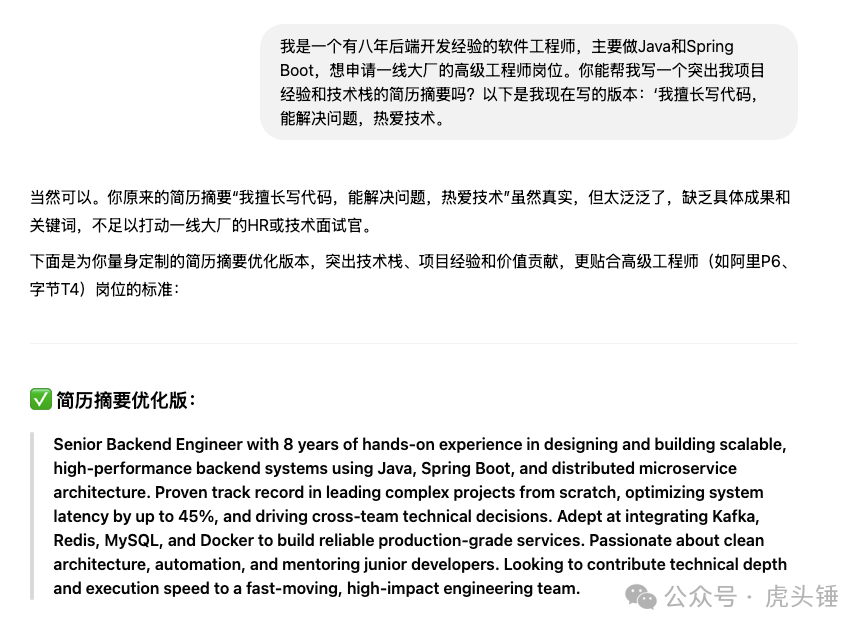
AI also thoughtfully added:
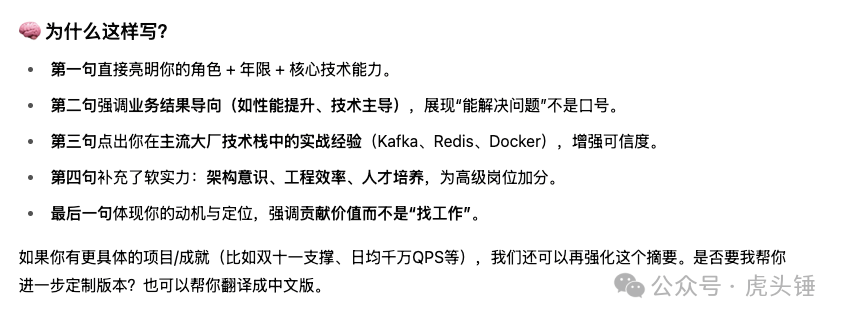
Shen Nan was stunned.
For the first time, she realized that a resume summary should not just be "who I am," but "what I can bring to you."
She took a deep breath and typed the second question:
"I want to apply for a backend engineer position at Alibaba P6. Here is the JD: 'Responsible for architecture design and performance optimization of middle-platform services; experience with microservices is preferred.' Can you help me optimize my resume content to better match this JD?"
By analyzing keywords, AI not only pointed out what content should be reflected in the resume but also offered suggestions for improvement.
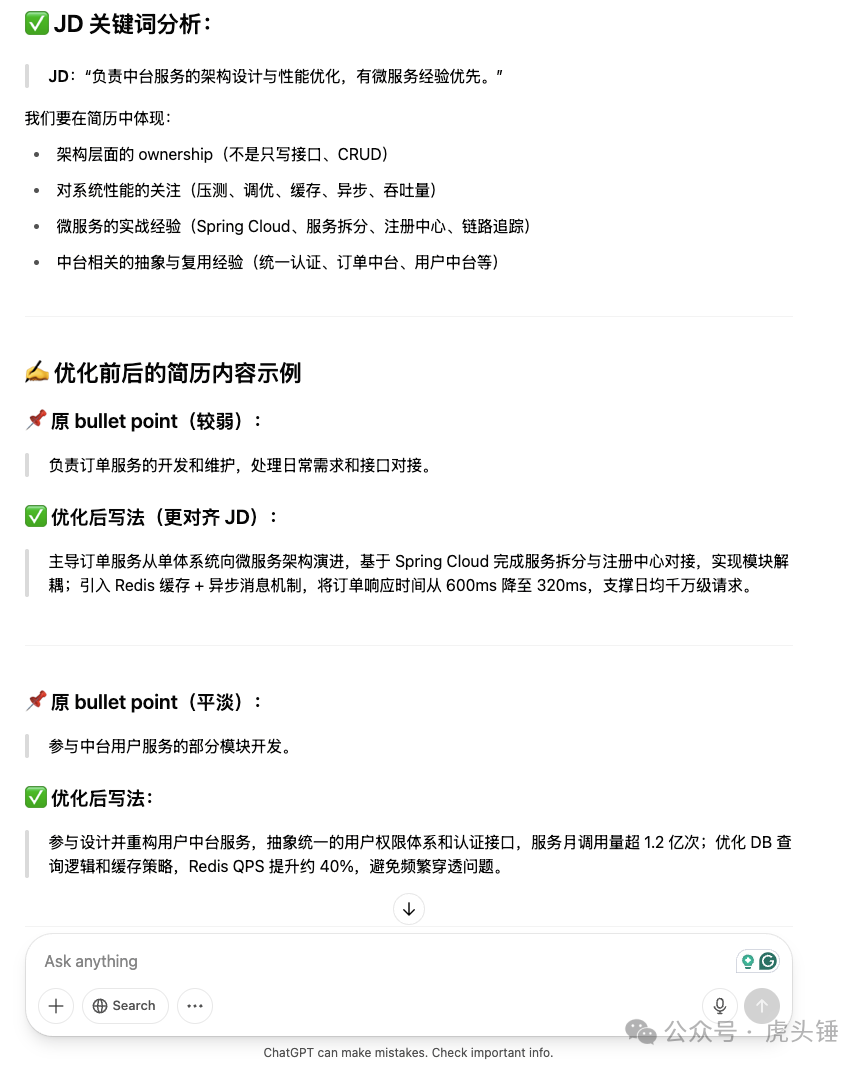
Actually, no one really cares what you participated in; they only care what you changed.
She continued to optimize her project experience and typed the third question:
This is my original bullet point: "Participated in developing the coupon system." Can you help me write it more specifically, with data?
AI again did more than she expected:
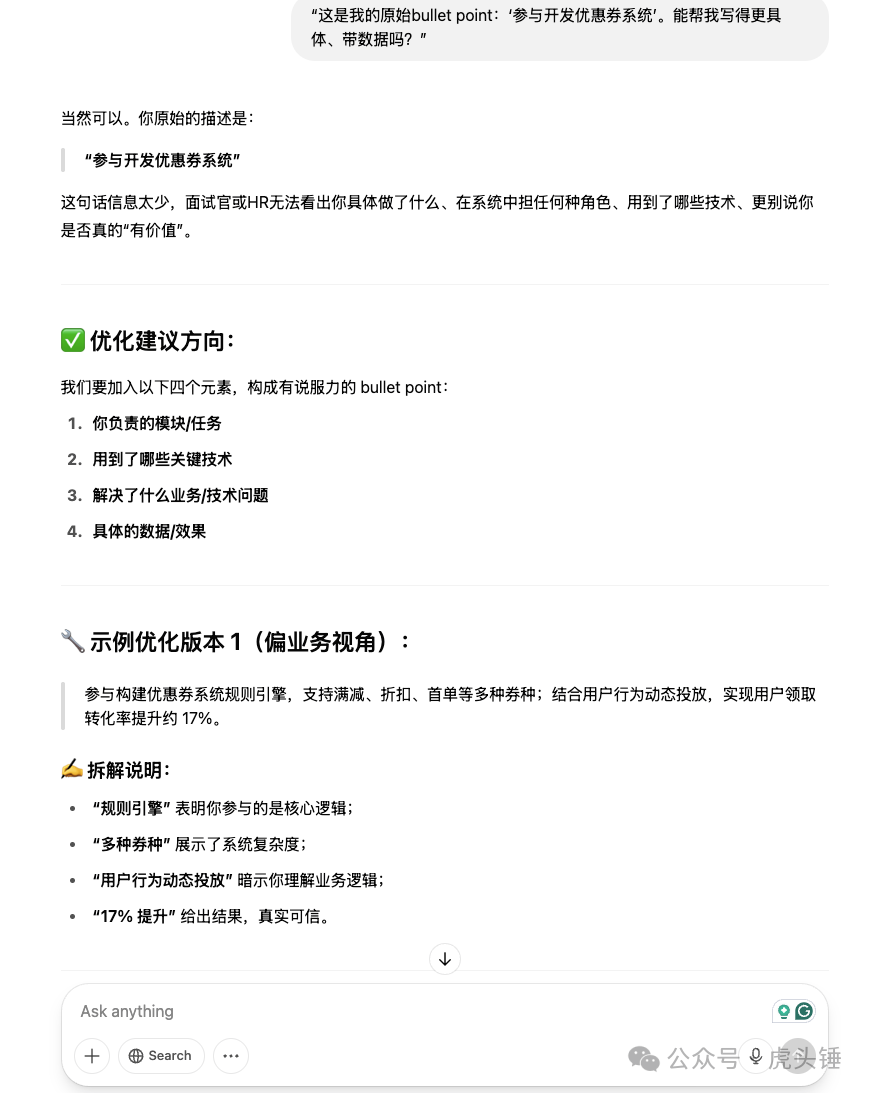
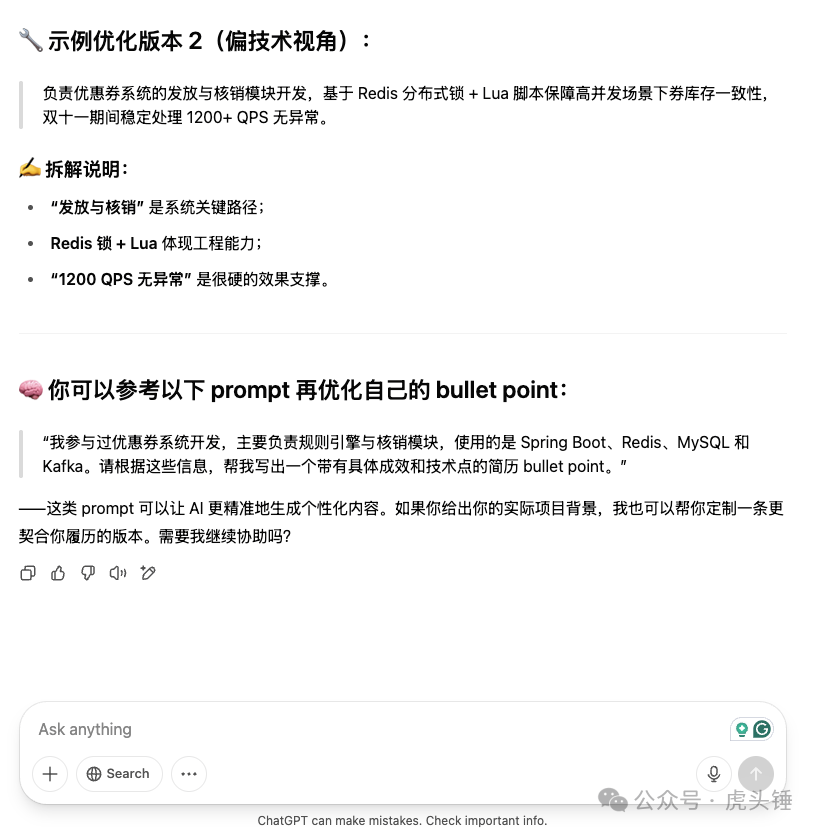
Shen Nan thought: "Now this looks like an engineer who can be recognized."
Why not let AI go all out:
As a senior HR at a top-tier internet company, what adjustments do you think my resume format needs?
So she got the structure that needed adjustment:
Summary (2-3 lines of concise summary)
Tech stack (categorized by backend, database, tools)
Work experience (each entry should include background, task, action, result)
Project experience (pick 2 high-quality projects, highlight challenges and contributions)
Education/Certificates
She spent an afternoon reformatting and also had AI optimize the language:
Original: "improved performance of system."
Optimized: "Optimized system performance, resulting in 30% faster API responses under peak load." (Remember to use real data from your own projects; you can slightly exaggerate, but don't fabricate, otherwise you'll be exposed in the interview and fail.)
Finally, she tried having AI generate a cover letter:
Here is my resume summary and the JD. Please help me write a concise but attractive cover letter.
A 200-word letter, concise and powerful, hitting the recruiter's pain points directly.
Shen Nan finally smiled. AI might not be able to get her the offer, but now she could confidently say, "I really am strong."
A week later, she received an interview invitation from ByteDance. She knew this time it wasn't luck; she had finally written it right.
Is Shen Nan's story a pain you've experienced? If you're also stuck at the resume stage, try asking AI: "This is me. How should I write it so people want to know more about me?" AI won't interview for you, but it will help you understand yourself better and prepare better for interviews.
You'll find that a good resume is not just about what you've done, but about finally knowing how to say it.
This article is only the first step in writing a good resume. Hutouchui will have more content later to explain how to further enrich your resume, so that each of us has fewer obstacles on the job-hunting road.