CHAPTER 37
Experienced Well-Being
Read It
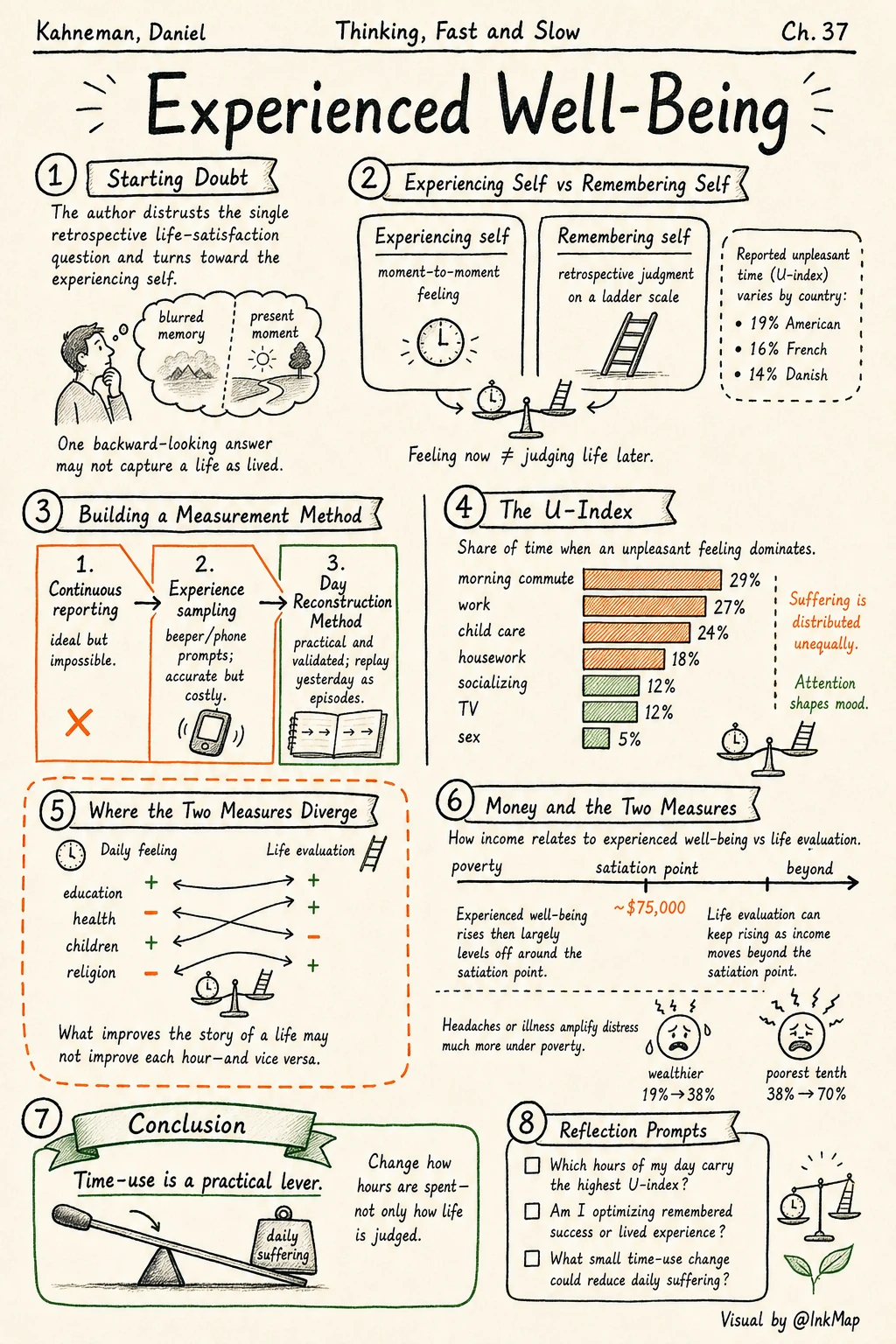
A person can give their life a nine out of ten and still want to escape most of its minutes. That split is the real subject of this chapter. Kahneman stops trusting the single retrospective question—How satisfied are you with your life?—and instead measures how people feel while they are actually living: on the train, at the desk, in the kitchen with a crying child. The Day Reconstruction Method turns a day into a series of episodes, each with an emotional label, and the U-index counts how many of those episodes are spent in a negative state.
The results are not flattering to our usual levers. More income keeps raising life evaluation forever, but after a point it does nothing for daily mood. Education changes how you describe your life, not how you feel during it. Marriage, children, even health—their effect on moment-to-moment well-being is far weaker than their effect on the story you tell about it. What actually moves the experiencing self is what you are doing and whether you can pay attention to it. Commuting and work are the worst; friends and focused play are the best. Poverty magnifies every other cost, but time use is a lever within reach.
 Open full image ↗
Draw It
The chapter contains two different notions of happiness that keep masquerading as one. One is a judgment made from outside a life, the other is the feeling of being inside it. The diagram separates them into two layers: a global evaluation on top, a stream of situated experiences underneath. The arrows show how weakly the top layer responds to the bottom. Overall satisfaction can rise while Tuesday afternoon gets worse. This is not noise; it is two selves answering two different questions.
Rethink It
A product team can be fooled by the same split. A learning app might have a high Net Promoter Score while every child who opens it feels a small wish to be somewhere else. The retrospective rating answers “Was it worth it?” but the daily grind answers “Do I want to keep going?” If I only look at the summary metric, I miss the three minutes of loading delay that quietly trains users to hate the product. The fix is to find the moment of maximum escape and redesign that, not to polish the overall score.
Take It With You
Well-being is not a verdict delivered at the end of a life. It is a running total of small yeses and noes. Any method that relies only on memory will systematically undercount the suffering people endure in silence. If I want to change how a life actually feels, I have to look at the clock, not the survey.