CHAPTER 27
The Endowment Effect
Read It
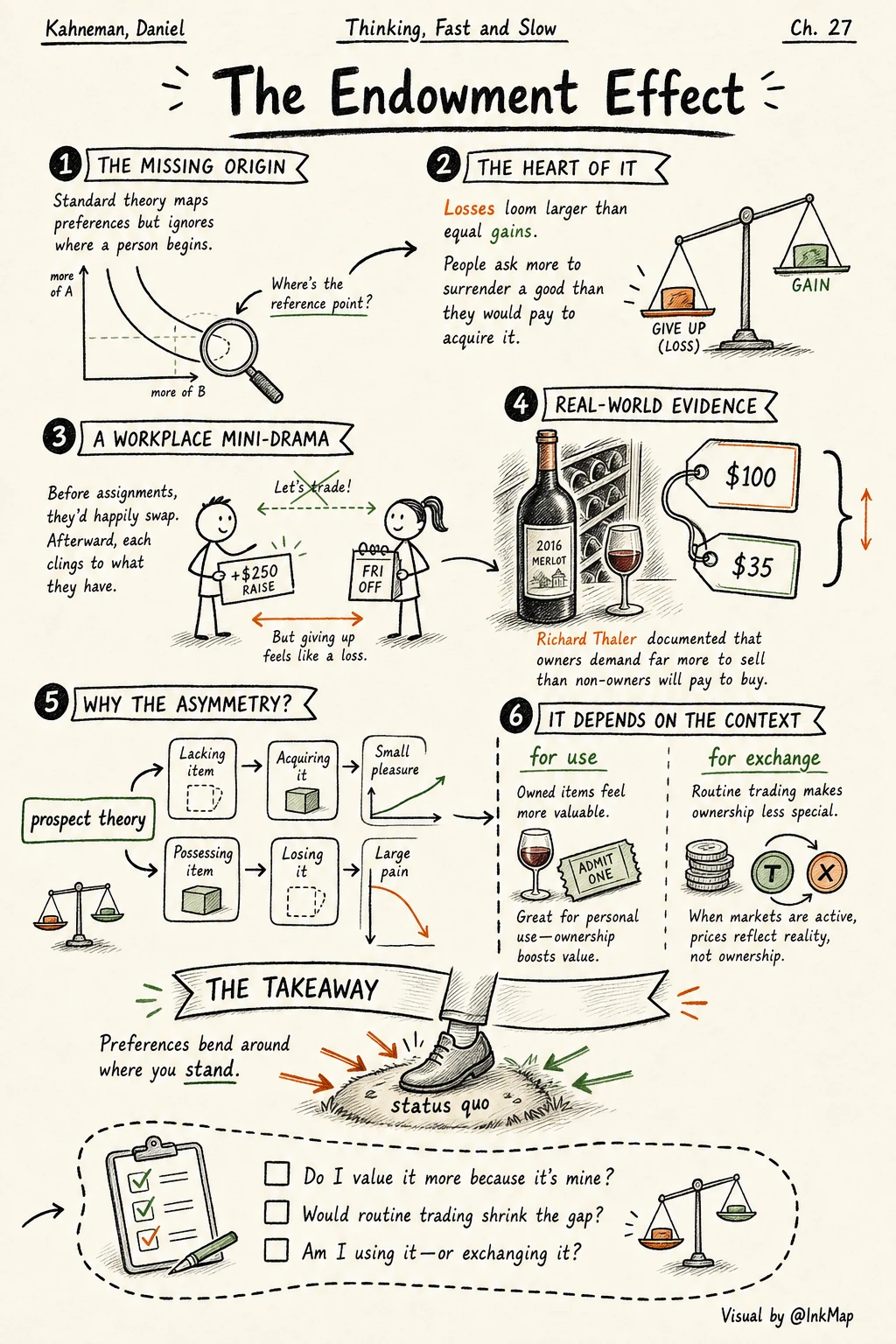
How much would you pay for a bottle of wine, and how much would you sell the same bottle for? The gap can be several times over. Standard economics finds this absurd: value should be independent of who holds the item. But once something truly belongs to you, the pain of giving it up outweighs the pleasure of having acquired it. The endowment effect isn't greed. It's loss aversion projected onto ownership. Owners fixate on what they stand to lose; non-owners fixate on what they stand to gain. The two sides feel the same object with different intensity.
This effect isn't universal. It appears for goods held for use—things you enjoy or consume—but not for goods held purely for exchange, like money or trading tokens. In our psychological accounts, objects are never neutral.
 Open full image ↗
Draw It
The gap between buying and selling prices is easy to misread as "sellers are greedy" or "buyers are cheap." The real structure is a standoff between two reference points. The diagram places owner and non-owner on opposite sides of the same object to show they aren't evaluating the same thing: one is weighing the pain of loss, the other the pleasure of gain. Layering on the distinction between "held for use" and "held for exchange" reveals that the endowment effect isn't a fixed human trait but a product of specific conditions.
Rethink It
The owner of a legacy code module often overestimates the cost of rewriting it, while someone who has never touched that code thinks a rewrite is trivial. They're not arguing about technical difficulty. They're arguing from different reference points: the owner is already imagining the loss of control, while the newcomer only sees the gain of cleaner code. Reframing the discussion from "should we rewrite?" to "who maintains it after the rewrite, and can we roll back?" brings the reference points closer together.
Take It With You
When someone values something far above market price, don't rush to call them irrational. Ask how long they've owned it, and whether they hold it for use or for exchange.