CHAPTER 19
The Illusion of Understanding
Read It
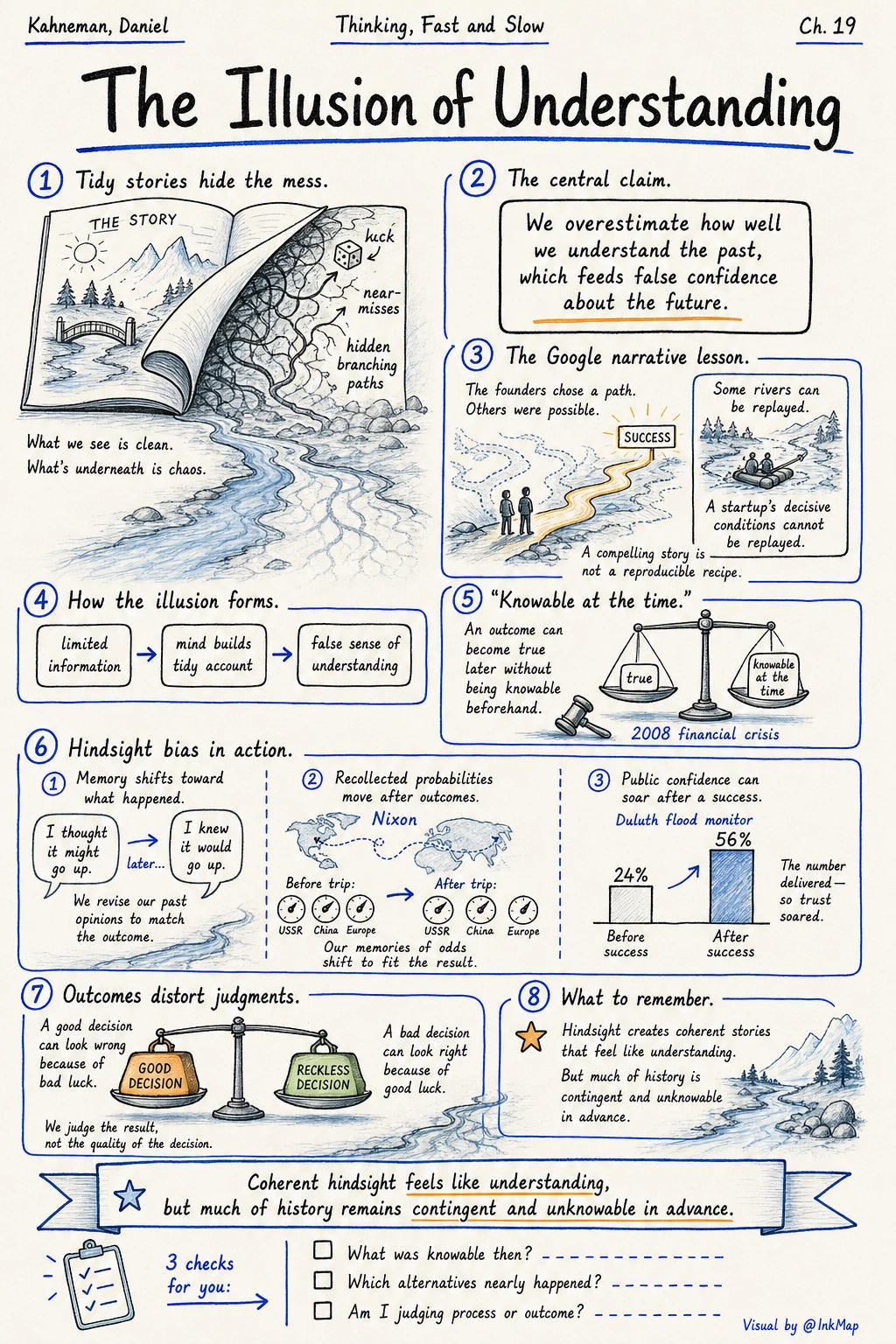
A smooth story makes the past feel inevitable—success was destined, failure was foretold. What gets ignored are the near-misses, the paths that could have happened but didn’t, and the weight of luck at every step. Hindsight bias isn’t just the embarrassment of “I knew it all along.” It makes decision-makers overestimate their predictive power in the next round, and it makes observers judge decisions by outcomes. The cost compounds quietly.
 Open full image ↗
Draw It
Prose often merges “information available at the time of the decision” with “what we know after the fact.” A good story sneaks the latter into the former, making it seem like the right call was obvious back then. Visually, the causal chain straightens out: the decision happens at a moment of incomplete information; the outcome is produced by decision, luck, and the things that never happened; narrative only picks up the last segment and works backward. The visual restores the systematically excluded node—the unrealized possibilities—which is exactly what makes the illusion of understanding work.
Rethink It
An architecture decision that turned out well gets written up as “we saw it coming.” But if the alternative also had strong reasons and luck simply landed on this side, treating the success as a repeatable method invites a hard fall next time. The more hidden cost is that reasonable decisions that failed due to bad luck become cautionary tales, pushing teams away from risky but correct choices.
Take It With You
A decision can only be judged by the information available when it was made, not by what happened afterward. Judging decisions by outcomes is the most common and most expensive cognitive tax in organizations.