CHAPTER 08
How Judgments Happen
Read It
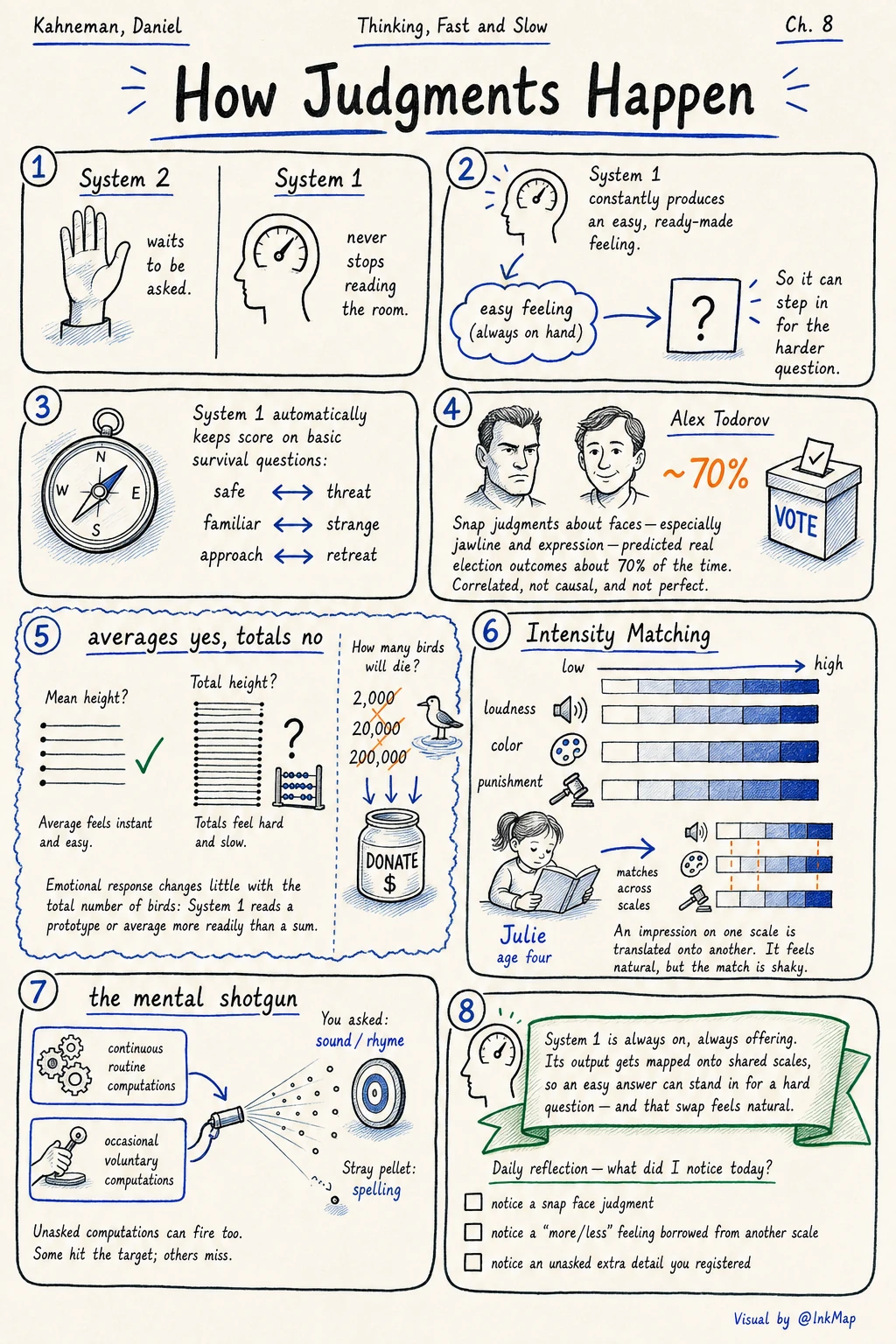
On the surface, this chapter is about automatic assessments of faces, averages, and intensity matching. The deeper question is why System 2 so often accepts those assessments as answers to hard problems. We think we’re evaluating whether someone is trustworthy; we’re actually replaying the feeling that flashed when we saw their face. System 1 generates evaluations continuously, and System 2, lazy by default, adopts them as conclusions.
 Open full image ↗
Draw It
This chapter needs layers. At the bottom are System 1’s automatic evaluations. Above that sits intensity matching, the cross-dimensional translation. Only at the top is System 2’s deliberate computation. Without the layers, the mental shotgun looks like a quirky side effect. With them, it becomes clear that System 1 doesn’t occasionally intrude; it runs constantly underneath, ready to hand up an answer.
Rethink It
In technology selection discussions, someone says “this framework feels more mature” and the room moves on. That feeling might come from clean documentation, professional community avatars, or a big company logo. System 1 generated the evaluation; System 2 adopted it. Nobody asked about totals, boundary conditions, or failure modes. When the discussion levels blur, decision quality disappears.
Take It With You
System 1’s evaluations aren’t errors; they’re defaults. System 2’s job isn’t to reject them but to decide when recalculation is worth the effort.