CHAPTER 06
Norms, Surprises, and Causes
Read It
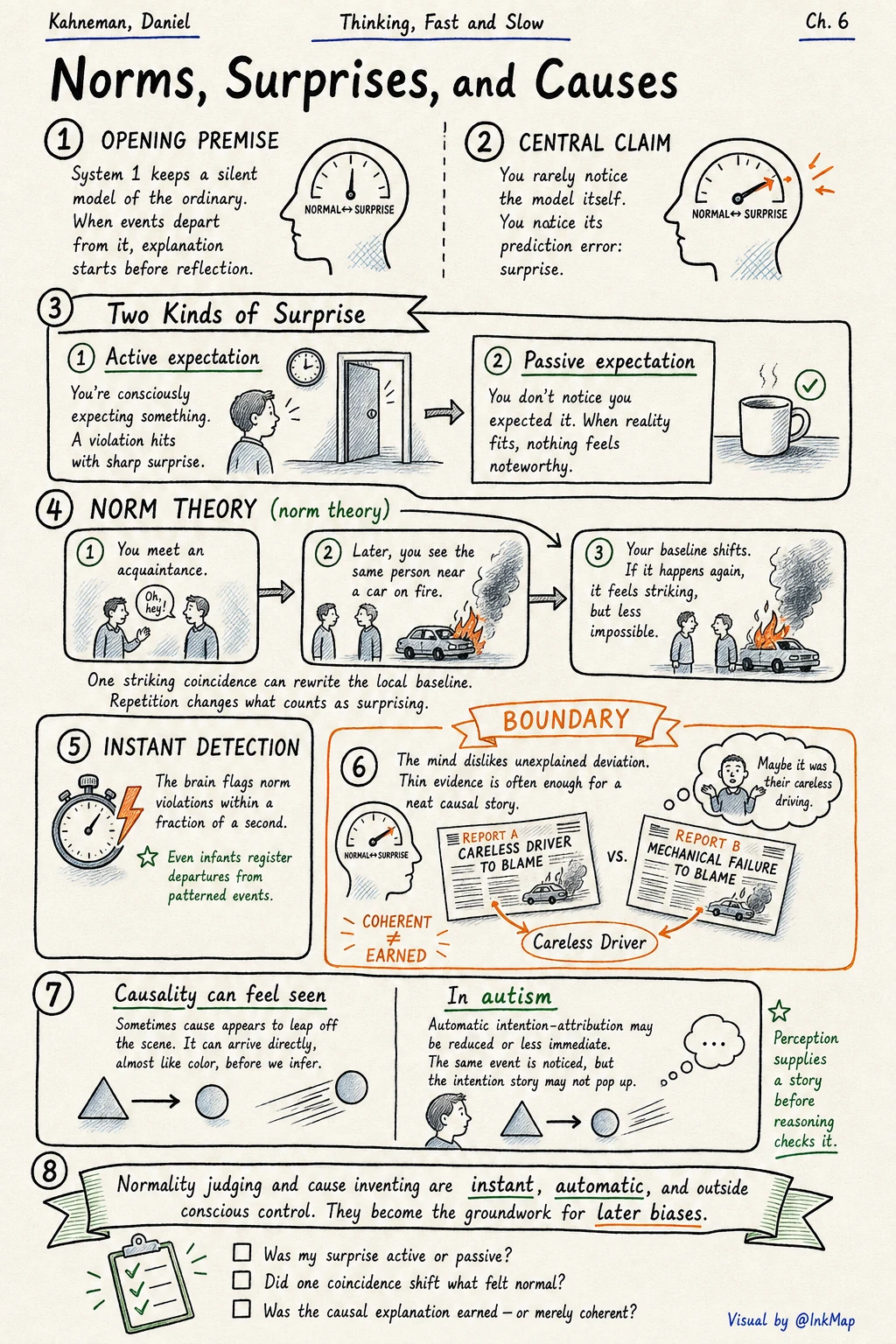
The question hiding inside this chapter is not “why do surprises feel surprising?” but “how does the brain decide what counts as normal?” System 1 keeps a running model of the world’s regularities, and any deviation from that model triggers surprise. But the model isn’t calibrated against facts; it’s calibrated against how smoothly associations flow. A coincidence that happens once gets reclassified as normal. A story that sounds coherent gets accepted as a causal explanation. We think we’re understanding the world, but mostly we’re just checking whether our associations hit a snag.
 Open full image ↗
Draw It
Listed as bullet points, this chapter becomes a grab bag: “norms shift,” “causality is invented,” “the Moses illusion exists.” But they form a structure. The norm model is the base layer. Surprise is its output signal. Causal explanation is the patch System 1 slaps on to make the surprise go away. Once that relationship is visible, causality stops looking like a separate faculty and starts looking like an automatic repair mechanism for a broken norm model.
Rethink It
In incident postmortems, the most dangerous sentence is “this happened before, so it’s not a surprise.” A single past event reshapes the norm, and the team stops treating the risk signal as a signal. More insidiously, once someone offers a coherent story— “the service just hiccuped again”—nobody asks for evidence. System 1 substitutes narrative smoothness for fact-checking.
Take It With You
Norms aren’t statistics; they’re habits of association. To break one, you have to manufacture surprise on purpose, not wait for it to arrive.