CHAPTER 01
The Characters of the Story
Read It
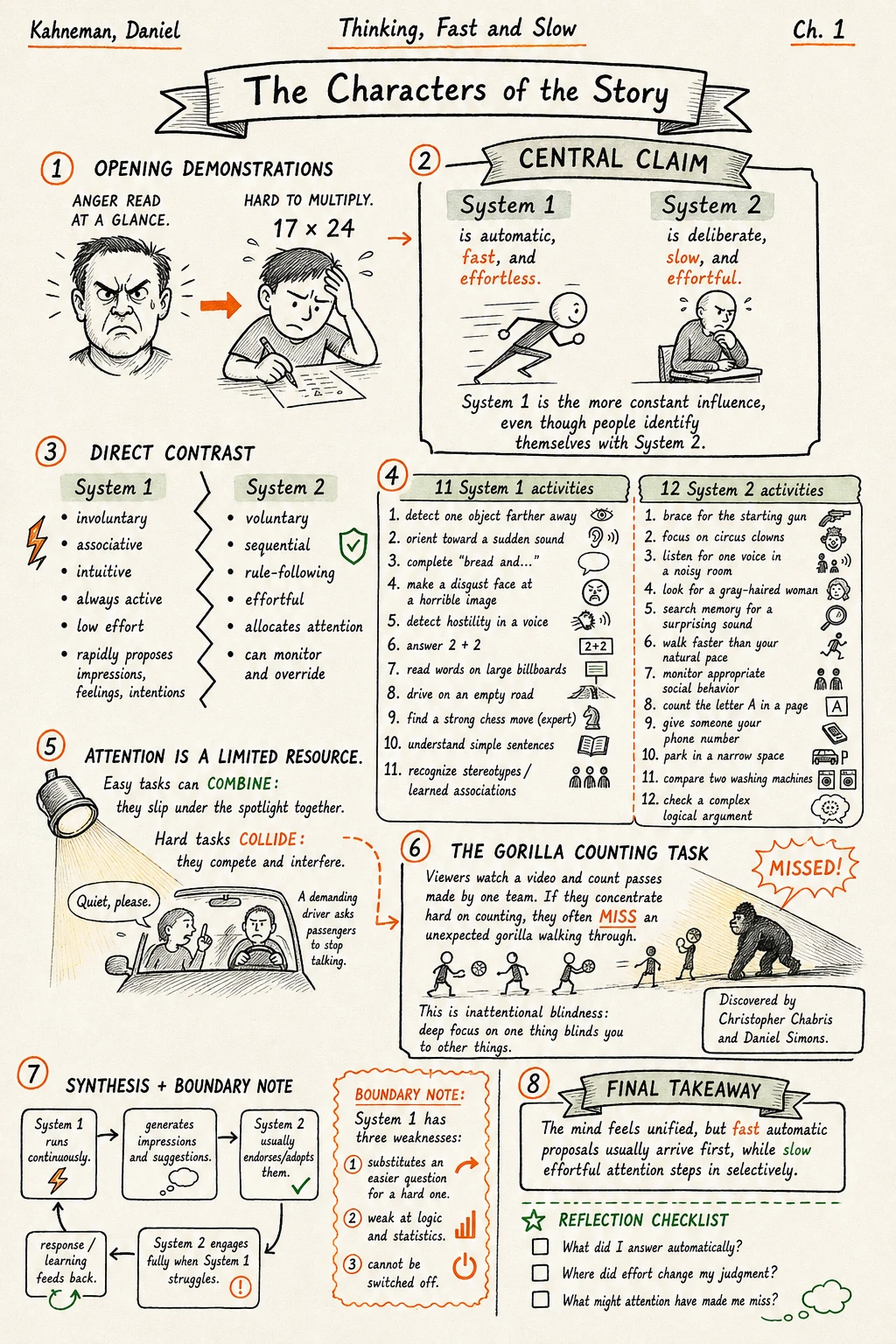
The easiest trap in this chapter is equating the self with System 2. We think we're thinking, but most of the time System 1 hands us an answer and System 2 just nods. Kahneman makes the division clear: System 1 is automatic, fast, effortless, and nearly impossible to turn off. System 2 is effortful, controllable, but lazy—it avoids work whenever it can. What deserves attention isn't that System 1 is fast, but that we don't notice it has already made the judgment for us.
 Open full image ↗
Draw It
In prose, two questions get flattened into one: who makes the decision, and who explains it? System 1 generates impressions, System 2 endorses them after the fact. These happen almost simultaneously, so reading them as one thing is easy. Putting the relationship into a diagram makes the contrast visible: System 1 is always on, System 2 only wakes up when something goes wrong or feels surprising. Most judgments start in System 1; System 2 just adopts them. The limits of attention also need to be marked separately, otherwise the invisible gorilla in later chapters looks like an isolated experiment instead of the same mechanism.
Rethink It
In a design review, someone says, "This architecture won't work," based on a first impression, then starts hunting for reasons. If we can't tell System 1 from System 2, we treat that intuition as a considered conclusion. Worse, System 1's judgments come with strong certainty, and System 2 is too lazy to overturn them. Knowing the division at least lets us ask in a review: did this judgment arrive as intuition, or did it come from actually comparing constraints?
Take It With You
System 1 isn't the enemy, and System 2 isn't the savior. What I need to train is the ability to notice when System 2 is slacking off.