CHAPTER 06
Paradigms of Interdependence
Read It
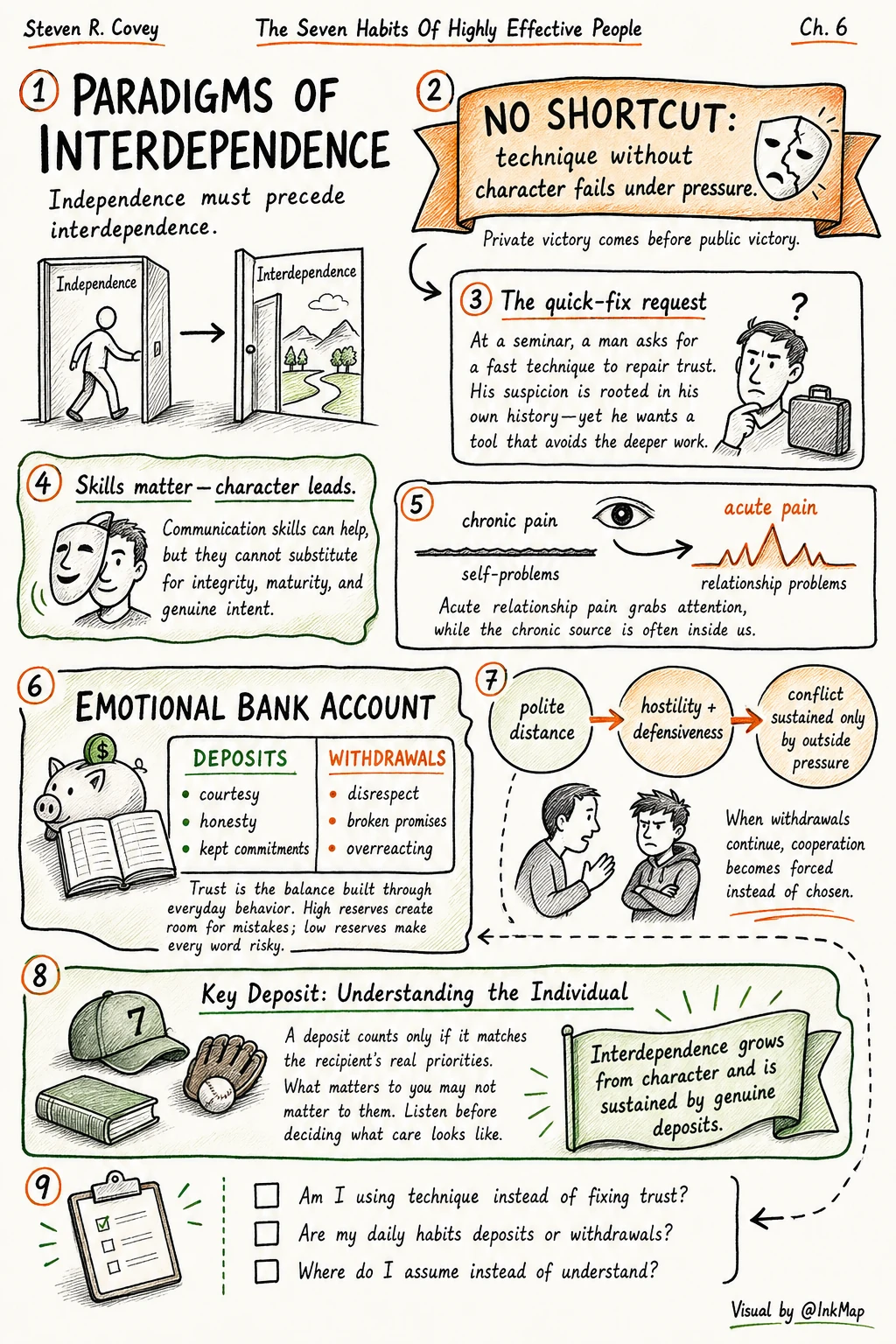
Before you can build anything durable with other people, you have to own your own life. That's the uncomfortable gate Covey sets at the entrance to the public victories. No amount of polished communication or conflict-resolution technique will hold if the person behind it hasn't done the private work of independence. The Emotional Bank Account makes this concrete: every interaction either deposits or withdraws trust, and the balance is what you're actually drawing on when things get hard. What struck me most is that the highest-value deposit isn't a grand gesture—it's understanding what the other person actually values. You can't assume your currency is theirs.
 Open full image ↗
Draw It
The sequence matters. Private victory, trust accumulation, and public victory form a causal chain, not a menu. Flattening this into prose makes it easy to miss that courtesy, honesty, and reliability aren't isolated virtues—they're deposits that create room for future disagreement. The diagram also shows that before any deposit, you need to know what counts as a deposit for the other person. That prerequisite is the quiet hinge of the whole chapter.
Rethink It
Teams often reach the point where someone says, "I've done so much for them," while the other person needed something entirely different—a clear boundary, a quick response, a promise actually kept. When a relationship is strained, the tempting move is to learn a new communication script. The harder and more useful move is to check whether the account has been overdrawn for years, and whether you've been depositing in the wrong currency all along.
Take It With You
Trust isn't the warm feeling you have when things are going well. It's the reserve that lets both people keep assuming good intent after a real disagreement. That reserve is built in ordinary moments, long before you need it.