CHAPTER 04
Habit 2: Begin with the End in Mind
Read It
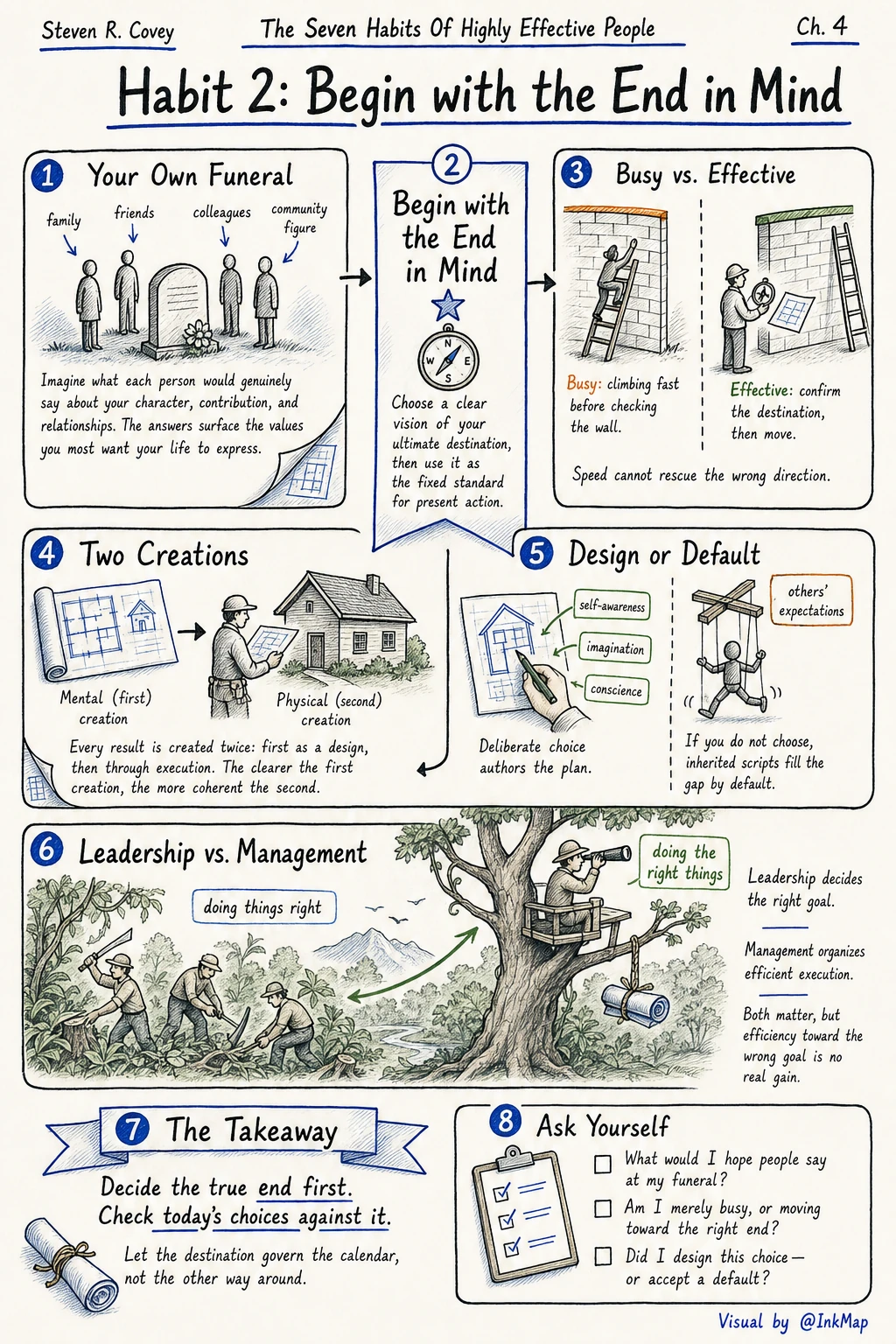
The most dangerous thing about busyness isn't the exhaustion. It's that being busy makes the question of direction feel unnecessary. The faster tasks get done, the easier it is to let someone else—or the environment—decide which wall the ladder is leaning against. Beginning with the end in mind asks you to complete the first creation before acting: clarify what result is worth pursuing and what principles can't be traded away. The second creation is planning, execution, efficiency. When the order is reversed, efficiency just helps you arrive faster at a place you never wanted to go. Covey's funeral visualization is a tool for surfacing what you actually value beneath the surface of ambition and to-do lists. The principle is simple: everything is created twice, first mentally, then physically. If you don't author that first creation deliberately, it gets filled in by default with other people's expectations and inherited conditioning.
 Open full image ↗
Draw It
Mental creation and physical creation have a sequential relationship. Leadership and management answer different questions: direction versus execution. Putting the four concepts together makes the distinction between "doing things right" and "doing the right things" concrete. The end isn't a fixed target either. It's a reference point for checking whether today's choices still serve the values you actually hold.
Rethink It
Before accepting a job, starting a project, or planning a year, writing down what you hope will remain afterward is often more useful than immediately listing tasks. It exposes how two options that both look good on the surface can serve completely different life directions. Even a time moat—a protected block of time—only matters if you know what you're protecting it for.
Take It With You
When direction is unclear, efficiency isn't an advantage. It just makes the drift happen faster.