CHAPTER 19
Interviewing for Staff-plus Roles
Read It
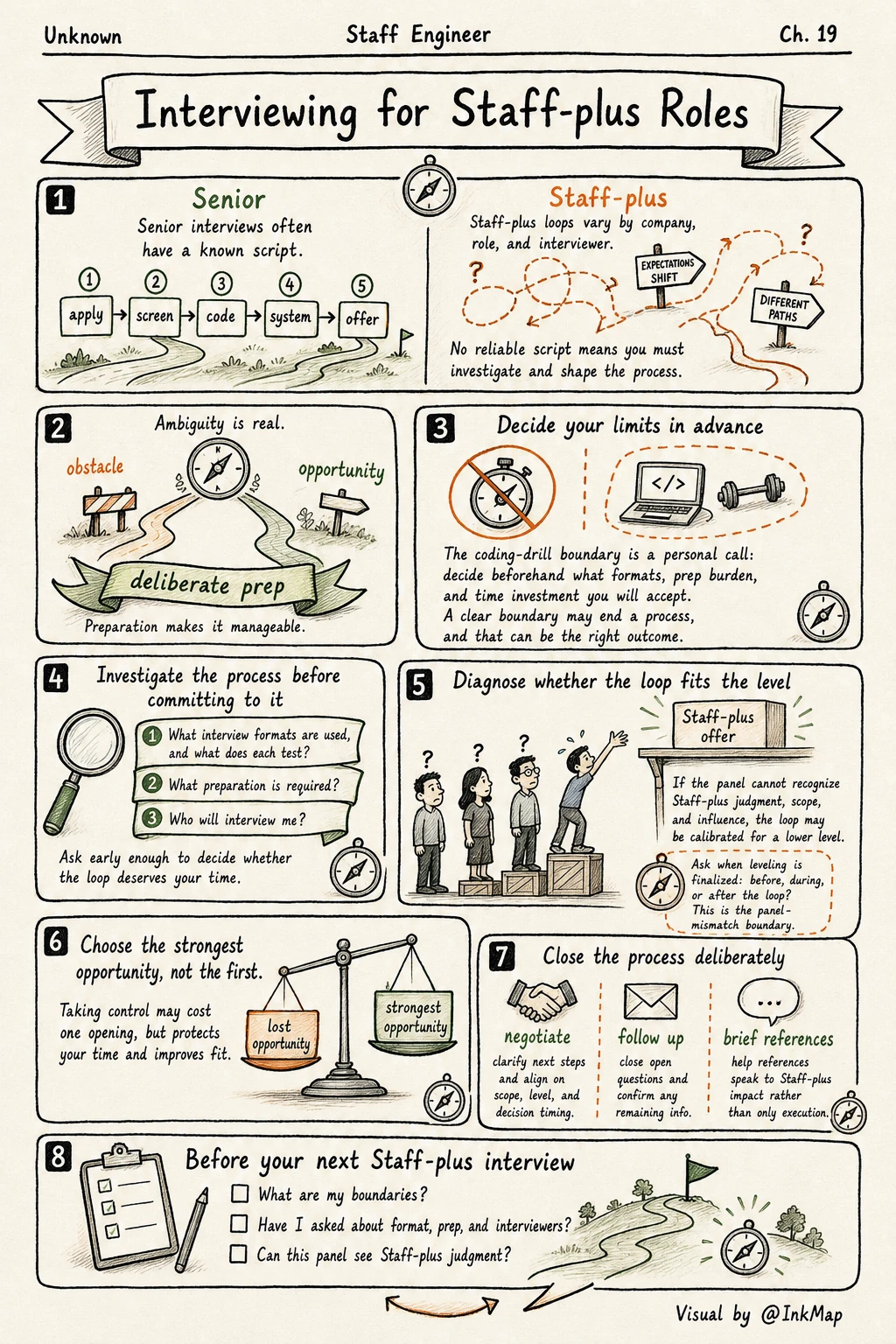
The most consistent thing about Staff-plus interviews is that they’re inconsistent. The process might be improvised, or it might be a Senior loop with a fancier title. If you just complete each round passively, you’ve handed over the responsibility of judging whether you’re being evaluated correctly. At this level, asking upfront about format, assessment criteria, interviewer backgrounds, and how leveling gets finalized isn’t pushy—it’s part of demonstrating that you can handle ambiguity. The chapter treats the interview as a two-way evaluation: the company collects evidence about you, and you collect evidence about whether their process can even recognize Staff-plus work.
 Open full image ↗
Draw It
This chapter becomes clearer when drawn as a loop rather than a list of tips. Preparation, questioning, presenting, leveling, and negotiation aren’t separate hurdles; they’re a continuous information flow that the candidate has to drive. If you map it that way, the interview stops being a gauntlet to survive and becomes a diagnostic tool. You’re not just answering questions; you’re testing whether the company knows what it’s looking for. The visual structure also makes visible the boundary-setting that has to happen before the loop starts—deciding what you will and won’t do to prepare, based on what this particular opportunity is worth.
Rethink It
If no part of the loop lets you explain past influence, or if the interviewers have never evaluated anyone near this level, a lower-than-expected leveling shouldn’t surprise you. Raising that mismatch directly is fair, not confrontational. Before entering a process, define your own floor: what level, scope, and compensation would make the effort worthwhile. That prevents spending weeks preparing for an evaluation system that was never designed to recognize what you actually do.
Take It With You
A Staff-plus interview doesn’t just test whether you’re qualified. It tests whether the company knows what it’s hiring for.