CHAPTER 16
Get in the room, and stay there
Read It
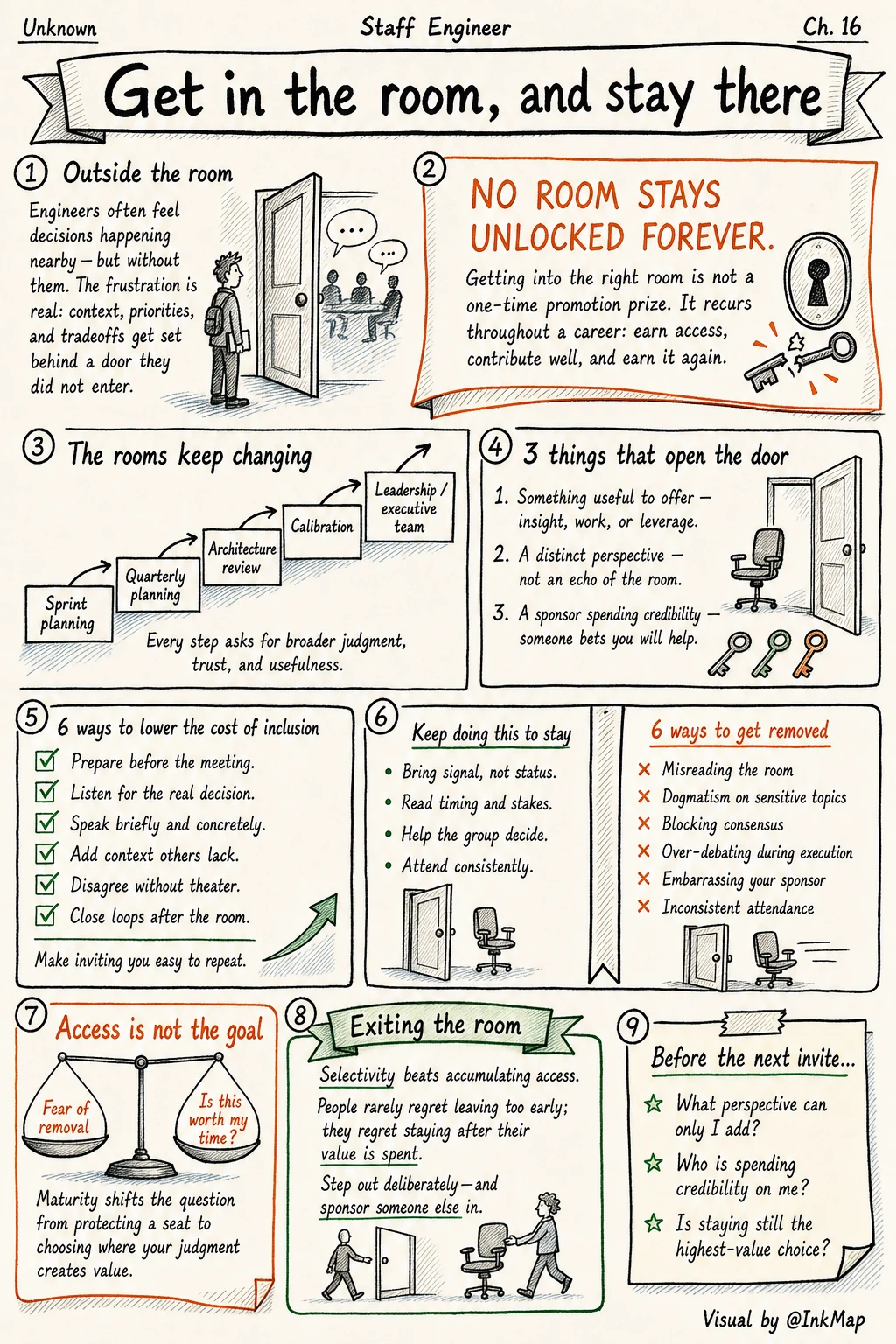
Every career has "rooms" where direction forms, resources get allocated, and real trade-offs happen. Entering once doesn't mean you keep the seat forever. You need to bring scarce value, have someone willing to vouch for you, and clearly express your intent to participate. Staying requires a different set of abilities—preparing well, communicating concisely, understanding what the room actually needs to accomplish, and not embarrassing the person who recommended you.
 Open full image ↗
Draw It
Getting in and staying in are two different sets of conditions, and leaving is a third action that's often forgotten. Drawing all three as a loop shows that career influence isn't about squeezing into more and more rooms; it's about repeatedly choosing among value, trust, and energy. Rooms are unlimited; attention is not.
Rethink It
Some people enter a decision meeting eager to prove their value, then keep reopening debates that already ended during execution. Others lose their seat's necessity through repeated absences. A more mature approach is to first judge whether the meeting is in exploration, decision, or execution, then contribute the information that phase actually lacks. When appropriate, actively hand the seat to someone better suited.
Take It With You
Getting into a key room proves you have value; knowing when you no longer need to stay proves you have judgment.