CHAPTER 14
How to Make Good Habits Inevitable and Bad Habits Impossible
Read It
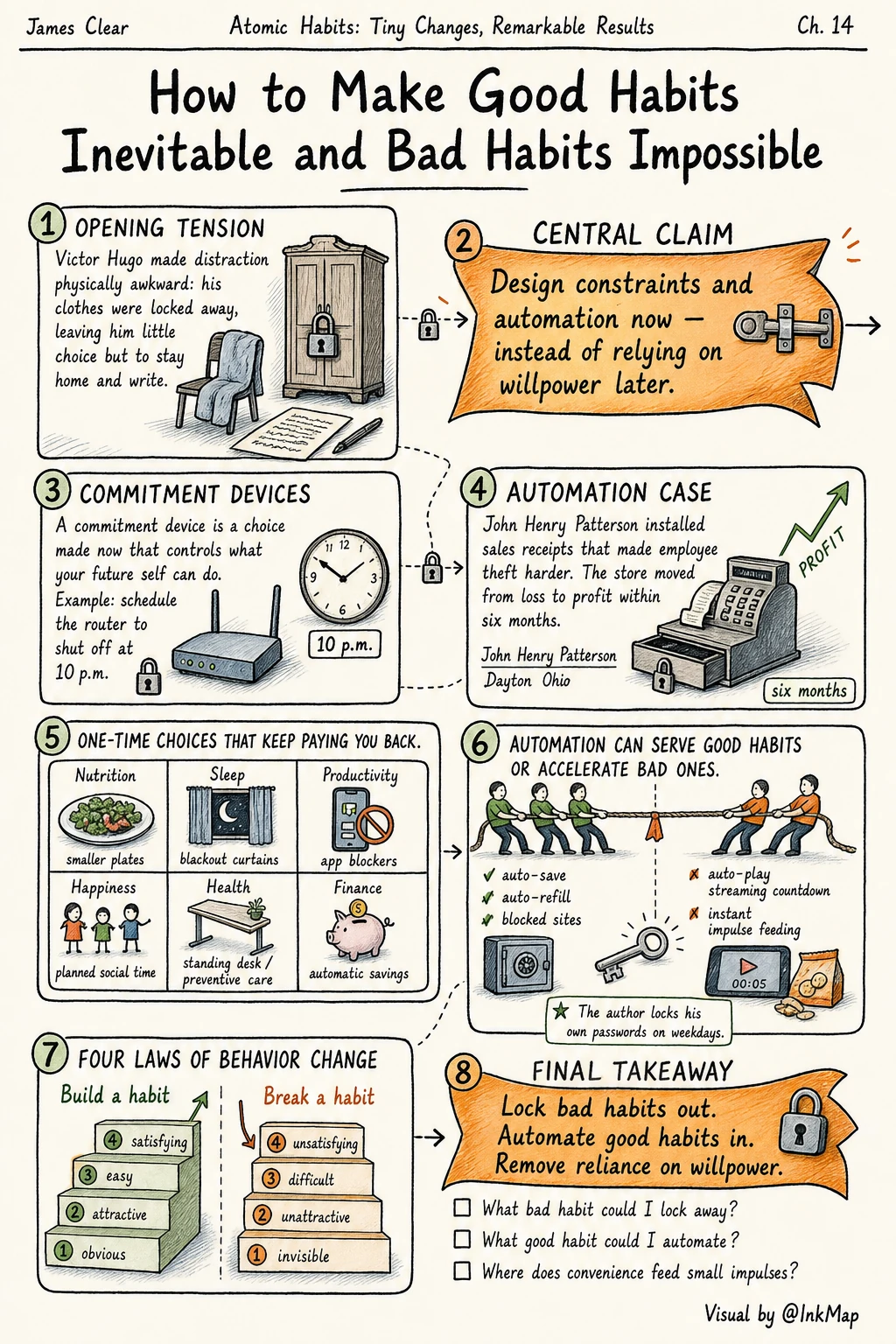
The most reliable way to shape future behavior is to make the decision now and remove the future choice. Victor Hugo locked away his clothes so he could not leave the house to socialize; the commitment device did the work his willpower could not. The insight is structural: a one-time action can lock in a repeated outcome.
Automation is the strongest form of this. A cash register that records every sale does not ask the clerk to be honest; it makes theft impractical. The same principle works for good habits—automatic savings, a better mattress, a phone with distracting apps removed. But automation cuts both ways. Auto-playing video platforms make stopping harder than continuing, which is why designing the system matters more than relying on the self.
 Open full image ↗
Draw It
The chapter closes the Four Laws by shifting the level of intervention. Instead of fighting temptation moment by moment, you change the architecture that makes temptation possible. A visual can layer this: one-time decisions sit above daily choices, and automation sits above both. That hierarchy explains why increasing friction on bad habits is often more powerful than resisting them directly.
Rethink It
A team wants fewer low-quality meetings. Asking everyone to exercise restraint every week is fragile. Changing the default—making meeting requests require a written agenda, or blocking focus time on calendars—changes the system. The discussion needs to separate the individual's intention from the structure that either supports or undermines it. Most failures are not willpower failures; they are design failures.
Take It With You
Commitment devices work because they are honest about human weakness. The cost is flexibility: locking away your clothes also locks away the option to change your mind. That is a real trade-off. Use commitment devices for decisions you want to protect from your future self, not for decisions that need ongoing judgment.